😱💔 SHE GAVE A SANDWICH TO A HOMELESS BOY… THEN SHE REALIZED WHO HE REALLY WAS!
Chapter 1: The Labyrinth of Gray Shadows
The air in the suffocatingly narrow passageway of the Scarlet Docks didn’t simply drift around me; it clung to my skin like a damp shroud.
It was a forgotten corner of the city’s architectural pride, an alley soaked in the smells of stagnant rain, rotting garbage, and old mortar crumbling between ancient bricks.
Just one block away, the towering glass skyscrapers of the Obsidian Gallery rose toward the sky, casting their long geometric shadows over this dilapidated passage like vultures waiting for a carcass to grow cold.
I pulled up the collar of my trench coat against the icy autumn wind, my leather boots striking the wet pavement in a hurried, uneven rhythm.
For five long years, my life had been reduced to a systematic and painful search through the darkest neighborhoods of the metropolis.
My name was Clara Vance, a woman who had once ruled at the top of a global shipping empire, until a ruthless coup orchestrated by my brother-in-law, Julian Croft, shattered my world into pieces.
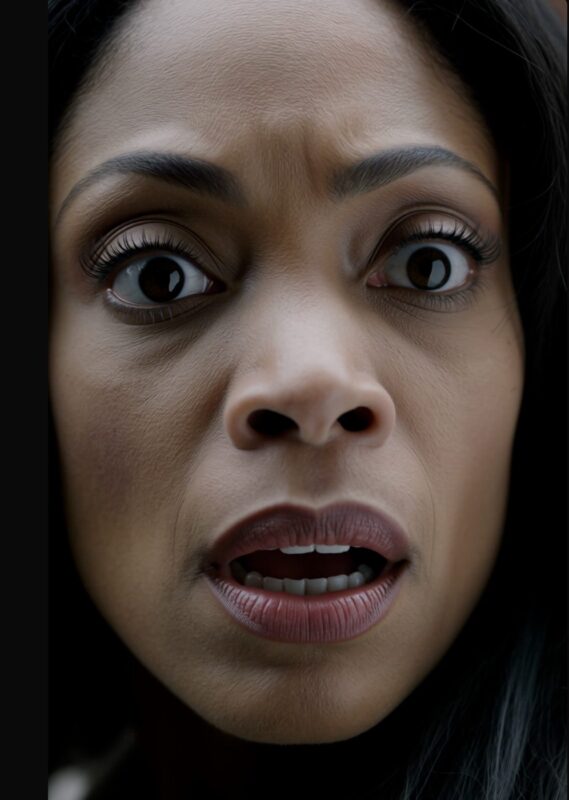
They had stolen my company.
They had falsified my late husband’s financial records.
But their most unforgivable sin dated back to the night they deliberately caused the chaotic fire that consumed our family estate—the night my seven-year-old son, Leo, disappeared into the black smoke.
The authorities had classified the case as a tragic disappearance, treating it as the final chapter in the destruction of an entire family lineage.
But a mother’s heart cannot accept that a case has been closed by corrupt compliance executives.
I knew he was still out there somewhere, a living ghost in a city built upon the bones of those society had abandoned.
“Mom, look at the sky,” a soft, melodic voice murmured, interrupting the turmoil of my thoughts.
I lowered my gaze to my six-year-old daughter, Emily.
She was a radiant beam of innocence amid the suffocating grayness of the afternoon.
She wore an immaculate white wool coat, and her bright blue bow shone like a forgotten fragment of summer.
She had no memories of the fire and couldn’t understand the defensive armor I wore every day to protect what remained of our broken family.
Before I could answer, Emily’s little hand slipped out of mine.
She didn’t wander away out of mischief. Instead, she moved forward with quiet determination and curiosity toward the dark entrance of a narrow passage between two walls of rusted warehouses.
“Emily, stay within the perimeter!” I shouted as a wave of icy terror tightened in my stomach.
I rushed after her.
I entered the dark passage.
The roar of traffic vanished instantly, replaced by the steady dripping of water from a broken copper drainage pipe suspended above our heads.
The shadows were thick, heavy with the smells of damp stone and forgotten memories.
I followed the white silhouette of my daughter’s coat until she stopped a few feet in front of me.
My heart pounded violently against my ribs when I saw what she was approaching.
Leaning against the wet brick wall, half-hidden behind a pile of abandoned shipping crates, was a dark, motionless figure.
Chapter 2: The Value of Kindness
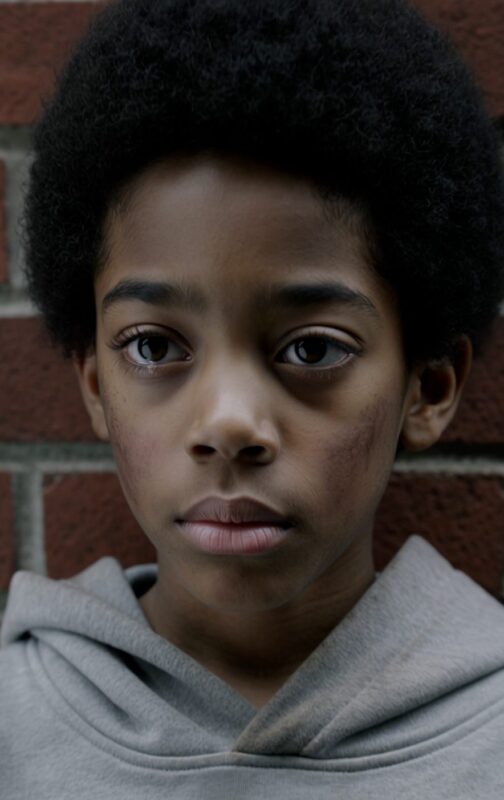
The child, curled up against the wall, had folded himself inward so tightly that he looked like nothing more than a discarded pile of rags.
He wore oversized gray clothes, worn and frayed, hanging loosely over his painfully thin body.
His knees were drawn against his chest in a desperate attempt to preserve what little warmth remained in him.
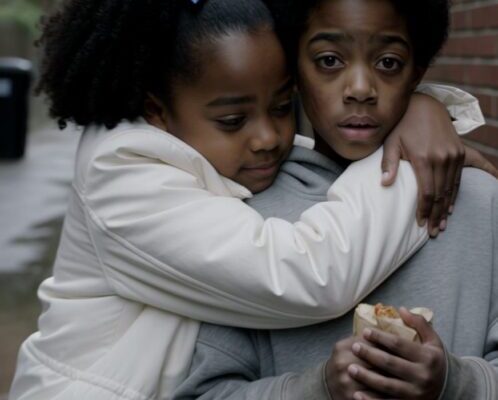
In his dirty, mud-stained hands, he held a freshly wrapped ham sandwich that had just been gently placed in his palms.
Emily stood directly in front of him, her white coat sharply contrasting with the boy’s gray misery.
“Here,” she whispered in a fragile, beautiful voice that seemed to purify the foul air of the alley for a moment.
“You can have it. Mom made it for my lunch, but I’m not hungry today.”
The boy slowly lifted his eyes.
His movements were stiff and mechanical from the biting cold.
The way he looked at the sandwich was heartbreaking.
It was the gaze of someone who had spent years learning that nobody ever gives you anything without demanding a price in return—one that strips you of your dignity.
His eyes were wide, hollow, and filled with deep confusion mixed with suspicion.
“Thank you,” he whispered in a hoarse, broken voice, like dead leaves rustling across concrete.
Then, before I could intervene, Emily did something that shattered the cold indifference I had spent years building around myself.
She leaned forward and wrapped her little arms around the boy’s neck, offering him a brief, innocent hug.
Just one second.
A gesture of pure, sincere compassion in a place devoid of light.
The boy froze completely.
His dirty hands remained clenched around the plastic sandwich wrapper, while his back stiffened against the cold wall.
It was obvious that kindness was foreign to him, like a currency so rare that he didn’t even know how to hold it without fearing he might break it.
Seeing my daughter touch a stranger in the dangerous docklands awakened every survival instinct I had developed during the ruthless battles of the business world.
I charged through the mist, my leather soles slapping violently against the wet asphalt.
“Emily, step away from him immediately!”
In two strides, I reached them.
I grabbed my daughter’s shoulders with desperate, protective force and pulled her behind me, shielding her with my own body.
My voice was strained, sharp, and distorted by uncontrollable fear, leaving Emily staring at me in complete confusion.
“Mom, stop,” Emily pleaded, tugging at the sleeve of my coat.
“Look at him. He’s just hungry. He doesn’t have a home.”
I turned my eyes toward the boy, my jaw clenched, ready to scold him harshly, call security, and keep my daughter away from the dangers of these outlying districts.
I opened my mouth to speak the words that would drive him away.
But the words died in my throat.
For the first time, I truly looked at his face.
Chapter 3: The Broken Balance
The harsh light of a flickering halogen bulb hanging beneath the warehouse eaves illuminated his features, revealing his face beneath the layer of dirt covering it.
My eyes traveled over the thick streaks of gray soot on his hollow cheeks, the deeply cracked and bleeding edges of his lips, and the overwhelming exhaustion etched across his forehead.
But it wasn’t the degradation of street life that stole my breath.
It was his eyes.
Emerald-green eyes, deeply sunken into their sockets, stared back at me—not with the predatory malice of a vagrant, but with a terrifying, defensive fear.
Something deep inside my chest broke forever.
A crack tore through my heart, shattering the years of coldness, calculation, and insensitivity I had built to survive.
My expensive leather handbag slipped from my numb fingers and crashed onto the damp pavement.
Its contents—my business documents, black bank cards, and keys—spilled into the muddy puddles of the alley.
I could no longer feel my hands.
I couldn’t even feel the icy rain intensifying and plastering my hair against my forehead.
The boy continued staring at me.
His body began trembling violently, his chest rising beneath his oversized gray shirt, as though a buried, suffocating memory were struggling to escape his throat.
His gaze traveled across my face, lingering on the familiar shape of my jaw, my eyebrows, and the silver hourglass-shaped watch I wore on my wrist.
The entire alley suddenly seemed to plunge into an unnatural, deathly silence.
The distant rumble of the industrial facilities disappeared.
Then, in a voice so weak and fragile that I could barely hear it, he whispered a single word:
“Mom?”
My breathing stopped completely.
That voice…
Broken by years spent on the streets, worn down by winters of hunger and loneliness, it still carried the unique, unforgettable melody of the child I had once rocked to sleep in his bedroom five years earlier.
It was Leo.
“Leo…” His name escaped my lips in a strangled sob.
I fell to my knees on the filthy concrete, paying no attention to the mud or shards of glass, and threw my arms around his frail, trembling body.
I held him against my chest, burying my face in his tangled, soot-covered hair.
He finally dropped the sandwich and grabbed the back of my cashmere coat with desperate, almost animalistic strength.
He wept uncontrollably.
His burning tears soaked my clothes as five years of separation and isolation collapsed in a magnificent embrace, as if time itself had finally returned what it had stolen from us.
But our refuge was brutally interrupted.
From the entrance to the alley came the heavy, rhythmic clatter of leather shoes against the brick walls.
It was accompanied by the low rumble of several luxury vehicles idling along the curb.
Through the gray mist, the blinding headlights of three black sedans illuminated our distress.
A tall figure stepped into the passage, accompanied by two heavily built compliance officers.
It was Julian Croft.
Chapter 4: The Final Reckoning
Julian stood beneath a large black nylon umbrella.
His perfectly tailored charcoal suit remained immaculate despite the rain.
His lips curled into a cruel smile filled with triumphant satisfaction.
He adjusted his gold signet ring and surveyed our tearful family with the cold, analytical gaze of a financial predator.
“Well, well, Clara,” Julian remarked in a mocking, condescending tone that made me tighten my grip on Leo’s shoulder.
“For five long years, I’ve paid international private investigators to search across borders for the Vance heir so I could finalize the liquidation of the estate.
“Who would have thought your little girl would find the missing heir in an alley full of garbage, all in exchange for a ham sandwich?”
“You left him to live on the streets, Julian,” I replied in a voice so cold it seemed capable of freezing the water gathering around my knees.
I slowly rose to my feet, keeping Leo and Emily firmly behind me.
“You knew he had survived the fire. You deliberately blocked his identification procedures in the regional registries so that his inheritance shares would automatically be declared abandoned.”
“Business is business, sister-in-law,” Julian replied with a dry, grating smile.
His guards slipped their hands inside their jackets, resting them firmly on their weapons.
“The company charter states that if the direct heir to the family lineage isn’t legally registered before his twelfth birthday—which happens to fall at midnight tonight—all voting rights will transfer to my group of shell companies.
“So, are you going to hand over the access credentials to that silver pocket watch, or will neither of your children ever leave this neighborhood?”
The red laser beams from their targeting devices drew threatening little dots across the fabric of Emily’s white coat.
Julian stepped forward, presenting a leather document folder like an executioner brandishing the record of his next victim.
He believed he had won the final battle and brought my dynasty to an end.
But he had forgotten who had built the company’s entire infrastructure.
“You’ve always trusted paperwork more than the actual way the system works, Julian,” I murmured, a calm, razor-sharp smile appearing on my face.
I glanced down at my smartwatch and touched its biometric tracking crystal.
With that gesture, I activated Vance Vanguard, my private security network, which had been monitoring my movements ever since I left the Obsidian Gallery.
At that very moment, the automatic circuit breakers throughout the warehouse district erupted in a brief shower of blue sparks.
The digital locks on Julian’s luxury vehicles disengaged.
Their alarms began screaming as the docks’ main electrical grid was disabled through a coordinated external intervention.
The roar of three armored utility vehicles tore through the silence of the alley.
My tactical response unit stormed through the perimeter gates from the neighboring street.
Beams from powerful flashlights flooded the passage, blinding Julian’s guards before they could even draw their pistols.
In less than ten seconds, the red laser dots disappeared from my daughter’s coat.
In their place, forty federal compliance agents were pinning Julian’s men against the old brick wall.
Julian stumbled backward against his own sedan.
His face turned gray as ash, making his tanned complexion look like a cracked mask.
The leather folder slipped from his fingers.
His forged restructuring documents scattered across the muddy puddles.
“The audit is over, Julian,” I declared, looking at him with absolute determination as agents fastened steel handcuffs around his wrists.
“Your assets are frozen, your business licenses have been revoked, and your name has been permanently erased from the registry.”
Epilogue: A New Definition of Home
Six months later, the morning sun rose beautifully above the spacious terrace of our new home, overlooking the Northern Emerald Bay.
The air was fresh, pure, and full of life.
It carried the delicate fragrance of blooming jasmine and damp pine needles—a world away from the suffocating exhaust fumes of the industrial docks.
I sat at a rustic iron table, a steaming cup of hot tea beside my digital terminal, my eyes fixed on the horizon.
In the tall grass of the yard, Leo ran around with a golden retriever puppy.
His laughter echoed through the valley like a radiant melody.
His tattered gray clothes were gone, replaced by a comfortable sweater.
His hollow cheeks had regained their fullness, and his face now radiated genuine health.
Beside him, Emily, her bright blue bow fluttering in the spring breeze, chased a butterfly with him through the clover.
Julian Croft had disappeared from our lives.
His name had been permanently blacklisted in financial registries throughout the hemisphere, and his future was now limited to a federal penitentiary, where compliance committees settled accounts without the slightest mercy.
We had lost five years in the dark shadows of the city, and the scars of our separation would forever remain etched into our family’s history.
But as I gazed at the open, endless horizon stretching before us, I knew that the oath of our family lineage had never truly been broken.
I was no longer a mother mourning the loss of a child who had become a ghost.
We were now the architects of our own future.
And, for the first time in our lives, the light belonged entirely to us.
If you’d like to discover more stories like this, or share what you would have done in my place, I’d love to hear your thoughts.
Your perspective helps these stories reach more people, so don’t hesitate to comment and share!