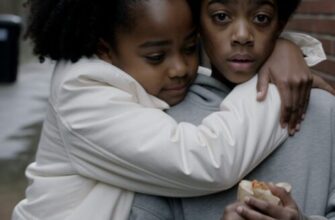
I was fourteen years old when I learned that losing your parents wasn’t the worst thing that could happen to a child. Sometimes, the cruelest pain comes from the people who are still alive.
It happened on a rainy Sunday afternoon.
My parents had gone to visit my grandmother in a neighboring town. I was supposed to go with them, but I had a school project to finish.
Before leaving, Mom kissed my forehead.
“Don’t forget to eat something, sweetheart. We’ll be home before dinner.”
Those were the last words I ever heard her say.
At six that evening, two police officers knocked on our door.
There had been an accident on the highway. A truck had lost control on the wet road and collided with my parents’ car.
Neither of them survived.
I remember standing in the hallway, staring at the officers, waiting for someone to tell me it was a mistake.
But nobody did.
Three days later, I stood beside two coffins, holding a photograph of our family vacation.
Our house was filled with relatives.
Aunts, uncles, cousins, and distant family members who had spent countless weekends at our home were suddenly everywhere.
They hugged me, cried, and promised I would never be alone.
My aunt Margaret even whispered, “We’re family, Emily. We’ll always take care of you.”
I believed her.
But after the funeral, everything changed.
One by one, the relatives disappeared.
When the social worker asked who would become my guardian, the room fell silent.
Aunt Margaret said her apartment was too small.
Uncle Robert claimed he couldn’t afford another child.
My mother’s cousin said her husband wouldn’t agree.

I called each of them myself.
“Please,” I begged. “I don’t need much. I can sleep on the couch. I can help with cooking and cleaning. I won’t cause any trouble.”
Nobody said yes.
The worst call was to Aunt Margaret.
“Emily, sweetheart, you have to understand. We all have our own lives.”
“But you promised Mom you’d always be there for me.”
She sighed.
“Your mother is gone, Emily. Things are different now.”
Then she hung up.
Two weeks after the accident, I was taken to a children’s home.
I carried one suitcase, a photograph of my parents, and the little silver necklace my mother had given me for my thirteenth birthday.
That first night, I cried until I couldn’t breathe.
I kept wondering what I had done wrong.
Why didn’t anybody want me?
For months, I watched other children receive visitors.
Some had grandparents who brought homemade cookies. Others had relatives who took them out for birthdays.
Nobody came for me.
Not once.
Eventually, I stopped waiting.
I studied hard, helped younger children with homework, and promised myself that one day I would build a life where nobody could make me feel unwanted again.
At eighteen, I left the children’s home with a scholarship and two hundred dollars in savings.
I worked in a café during the evenings and attended nursing school during the day.
Life wasn’t easy.
There were nights when I ate nothing but bread and tea.
There were birthdays when I bought myself a cupcake and pretended I didn’t mind celebrating alone.
But slowly, things improved.
At twenty-six, I became a registered nurse.
At twenty-nine, I married a kind man named Daniel.
And at thirty-two, I finally had something I had dreamed about since childhood.
A family of my own.
Then, one October morning, eighteen years after my parents’ accident, someone knocked on my door.
Standing outside were an elderly man and woman.
The woman held a faded photograph.
“Are you Emily Carter?” she asked.
“Yes.”
Her eyes filled with tears.
“My name is Rose Bennett. This is my husband, Thomas. We knew your parents.”
I froze.
Rose handed me the photograph.
It showed my mother sitting beneath an apple tree, smiling beside a younger Rose.

“I’ve been looking for you for years,” she whispered.
I invited them inside.
And what they told me changed everything.
Rose explained that she had been my mother’s closest friend since childhood.
Before the accident, my parents had asked Rose and Thomas to become my guardians if anything ever happened to them.
They had even signed legal documents.
I stared at her.
“Then why didn’t you come for me?”
Thomas lowered his head.
“Because we were told you had been adopted by your aunt Margaret.”
My hands began trembling.
“What?”
Rose reached into her handbag and pulled out a thick envelope.
“Your aunt sent us a letter. She said you were living happily with her family and didn’t want contact with anyone connected to your parents.”
I opened the envelope.
There was Margaret’s handwriting.
And then I saw something that made my blood run cold.
A second document.
A financial statement.
My parents had left me a substantial inheritance, including the family home and a savings account.
I had never received a penny.
“Margaret handled the estate,” Thomas explained. “We recently discovered that the house was sold shortly after your parents died.”
I could barely speak.
For eighteen years, I had believed my family rejected me because I was a burden.
But now I wondered whether there had been another reason.
With Rose and Thomas’s help, I hired a lawyer.
The investigation took months.
Eventually, we discovered that Margaret had concealed the guardianship documents, provided false information about my living arrangements, and diverted money intended for my care.
The woman who told me she couldn’t afford to raise me had used my inheritance to buy herself a beautiful house.
When I finally confronted her, she didn’t even apologize.
“Your parents left you more than you needed,” she said coldly. “I had children of my own to think about.”
I looked at her for a long moment.
“And I was a child too.”
For the first time, Margaret had nothing to say.
Legal proceedings followed, and I recovered part of my inheritance.

But money wasn’t what mattered most.
It was learning that my parents had made arrangements to protect me.
They hadn’t left me forgotten.
Someone had taken away the family they wanted me to have.
Over the following months, Rose and Thomas became part of our lives.
They came for Sunday dinners, celebrated my birthday, and told me stories about my parents that I had never heard.
One afternoon, Rose brought me a small wooden box.
“Your mother gave me this before you were born,” she said. “She asked me to keep it safe.”
Inside was a handwritten letter.
The final sentence read:
“My greatest wish is that our daughter grows up knowing she is loved, even on the days when the world makes her feel otherwise.”
I cried for a long time.
Not because I was fourteen again.
But because, after eighteen years, that frightened little girl finally had an answer.
Today, Rose and Thomas are in their eighties.
They sit together in our garden every Sunday while my daughter runs between the apple trees.
Sometimes, watching them laugh, I think about the family I lost and the family I eventually found.
And I have learned something I wish every abandoned child could know.
Being rejected by your relatives doesn’t mean you are unworthy of love.
Sometimes, the people who share your blood are the ones who hurt you most.
And sometimes, two strangers standing at your door can give you back the family you thought was gone forever.
But there is one thing I will never forget.
The day my parents died, I lost my childhood.
The day Rose and Thomas found me, I finally got a piece of it back.