My husband looked at our newborn daughter for exactly forty seconds before saying the words that would eventually end our marriage.
“That baby isn’t mine.”
I was still lying in the hospital bed, exhausted after seventeen hours of labor.
Our daughter was wrapped in a pink blanket against my chest. She had beautiful black curls, dark eyes, and warm olive skin.
My husband, Nathan, had blond hair and blue eyes.
So did I.
“Nathan, what did you just say?”
He stood near the window, his arms folded.
“Look at her, Olivia. Just look at her.”
“I am looking at her. She’s our daughter.”
“Then explain why she looks nothing like either of us.”
I stared at him, waiting for a smile.
There wasn’t one.
“Nathan, genetics don’t work the way you think they do.”
He shook his head.
“My mother warned me this might happen.”
And suddenly, everything made sense.
His mother.
Margaret.
The woman who had never believed I was good enough for her son.
I didn’t know it then, but her poisonous suspicions would uncover a crime so horrifying that even the detectives investigating it would struggle to believe what they found.
And the worst part?
The woman responsible had been standing beside my hospital bed, smiling at me, just hours after my daughter was born.
My name is Olivia Bennett. I was thirty-one when my daughter was born.
Nathan and I had been married for eight years.
We lived in a quiet neighborhood outside Portland, Oregon. We had a beautiful house, two dogs, and what I believed was a happy marriage.
For five years, we had struggled to have a baby.
There had been fertility treatments, miscarriages, and nights when I cried myself to sleep.
When I finally became pregnant, Nathan had fallen to his knees and kissed my stomach.
“You’ve made me the happiest man alive,” he’d whispered.
I remembered those words while he stood in my hospital room accusing me of betrayal.
Our daughter, whom we named Lily, had been born healthy.
Or so we thought.
Six hours after delivery, a nurse named Vanessa Reed entered my room.
She was in her late fifties, with short silver hair and a warm, grandmotherly smile.
“We need to take your little princess for a few routine checks,” she said.
“Is something wrong?”
“Not at all, sweetheart. Just standard newborn monitoring.”
She gently lifted Lily from my arms.
I remember something strange about that moment.
Vanessa stared at my face for several seconds.
Then she asked, “Was your maiden name Whitmore?”
I blinked.
“Yes. Why?”
Her smile disappeared for a fraction of a second.
“Oh, nothing. I used to know a family with that name.”
Then she carried my baby away.
Lily was gone for almost four hours.
When Vanessa finally brought her back, I was half asleep.
“Here she is,” the nurse whispered. “Safe and sound.”
She placed the baby beside me and hurried out.
I never imagined that those four hours would become the center of a murder investigation.
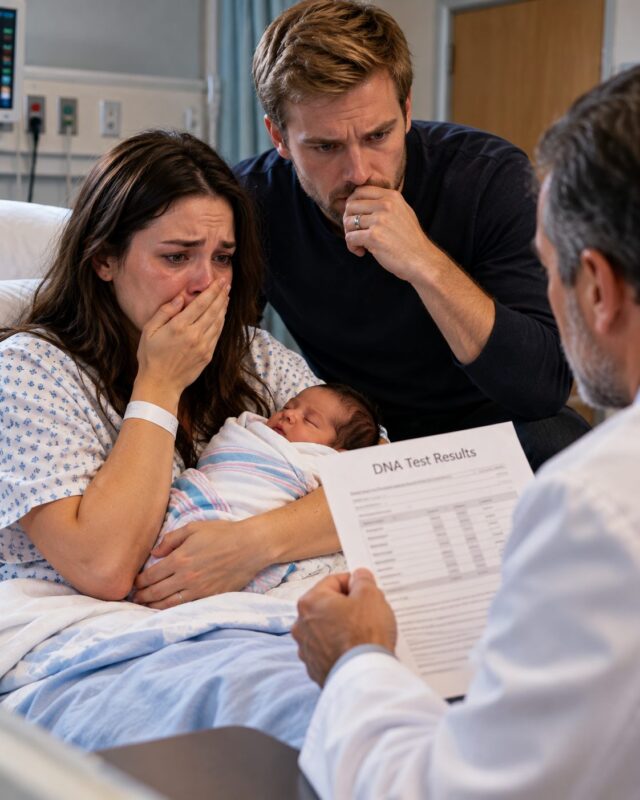
Three weeks later, Nathan demanded a DNA test.
It happened during dinner.
His mother had visited earlier that afternoon, spending nearly an hour examining Lily’s face.
When Margaret left, Nathan became unusually quiet.
Finally, he put down his fork.
“I’ve scheduled a paternity test.”
I looked at him.
“You’ve done what?”
“I need to know the truth.”
“The truth about what?”
“Whether Lily is actually my daughter.”
For a moment, I couldn’t speak.
Then I laughed.
Not because it was funny.
Because I couldn’t believe the man I loved had become a stranger.
“After eight years together, you think I cheated?”
“I’m not accusing you of anything.”
“You just scheduled a DNA test without telling me!”
He looked away.
“My mother thinks—”
“I don’t care what your mother thinks!”
Lily started crying in the next room.
I stood up.
“Fine. We’ll take the test.”
Nathan looked relieved.
“But I’m taking one too,” I added.
He frowned.
“What for?”
“Because I want a complete family DNA panel. If you’re going to question our daughter’s identity, we’re checking everything.”
He shrugged.
“Whatever makes you comfortable.”
Ten days later, the clinic called.
The receptionist sounded nervous.
“Mrs. Bennett, Dr. Adrian Keller needs to see you tomorrow.”
“Did the results come back?”
“Yes.”
“Can you email them?”
“I’m afraid the doctor would prefer to discuss them in person.”
“Should my husband come?”
There was a long silence.
“No, Mrs. Bennett. Please come alone.”
The next morning, Dr. Keller was waiting for me.
He closed his office door.
Then he placed a thick folder on the desk.
“Olivia, I need you to remain calm.”
My heart began pounding.
“Is Nathan Lily’s father?”
He hesitated.
“No.”
I felt as though someone had punched me.
“That can’t be right.”
“The laboratory repeated the analysis.”
“I’ve never been with another man!”
“I believe you.”
“Then how can you possibly—”
“Because there’s another result.”
He slid a second page toward me.
I looked at the numbers.
I didn’t understand them.
“Olivia,” he said quietly, “the test shows that you are not Lily’s biological mother either.”
I stared at him.
Then I started laughing.
It was a terrible, hysterical laugh.
“That’s impossible. I gave birth to her.”
“I understand.”
“No, you don’t understand! I was awake! I held her! I watched the doctor cut the cord!”
Dr. Keller leaned forward.
“I’m not questioning whether you delivered a baby.”
“Then what are you saying?”
“I’m saying the baby currently living in your home is not the child you delivered.”
The room went silent.
I could hear the hum of the air conditioner.
Finally, I whispered, “Someone switched my baby?”
“We need to investigate that possibility immediately.”
I remembered Vanessa.
The nurse.
The four hours.
The strange question about my maiden name.
“Oh, my God.”
By that afternoon, the hospital’s administration had been notified.
Two days later, police became involved.
Detective Hannah Brooks arrived at our house with a folder and a grave expression.
Nathan sat beside me.
Margaret had insisted on being present.
Detective Brooks opened her folder.
“On the night your daughter was born, three other baby girls were delivered in the maternity unit.”
I gripped Nathan’s hand.
“One of those babies was transferred to neonatal intensive care.”
“Why?” I asked.
“Severe respiratory complications.”
“And?”
The detective hesitated.
“She died eleven hours after birth.”
My stomach dropped.
“Are you saying my daughter died?”
“We don’t know yet.”
Margaret suddenly spoke.
“This is ridiculous. Hospitals don’t just switch babies.”
Detective Brooks looked at her.
“Mrs. Bennett, hospital records show that two newborns were assigned the same identification number that night.”
Nathan leaned forward.
“How is that possible?”
“Someone manually changed one of the records.”
The detective placed a photograph on the table.
It showed a nurse in blue scrubs.
Vanessa Reed.
I pointed at her.
“That’s the woman who took my baby.”
Detective Brooks nodded.
“We know.”
“Where is she?”
“That’s what we’re trying to find out.”
“What do you mean?”
“Vanessa Reed resigned forty-eight hours after your discharge. Her forwarding address was false.”
Then the detective said something that made Margaret’s coffee cup slip from her fingers.
“We also discovered that Vanessa knew your family long before Lily was born.”
I frowned.
“My family?”
Detective Brooks looked directly at Margaret.
“No. Your husband’s family.”
Margaret went completely white.
The truth began emerging three days later.
Vanessa Reed had worked as a maternity nurse for nearly twenty-seven years.
Before that, she’d been employed at a private medical practice owned by Nathan’s late father, Dr. Richard Bennett.
But she hadn’t simply worked for him.
They had been lovers.
And twenty-nine years earlier, Vanessa had given birth to a baby boy.
A baby she claimed Richard had taken away from her.
According to her old journals, Richard told Vanessa that their son had died shortly after birth.
But she never believed him.
She spent years searching for the child.
Eventually, she discovered something that convinced her the baby had survived.
His birth records had been altered.
And Richard’s wife, Margaret, had adopted a newborn boy during that same year.
My husband.
Nathan.
When Detective Brooks revealed this, I turned toward him.
His face was frozen.
“What are you saying?” he whispered.
The detective looked at Margaret.
“Mrs. Bennett, we need to know whether Nathan was legally adopted.”
Margaret began shaking.
“No.”
“Margaret?”
“No! You don’t understand!”
Nathan stood up.
“Mom, answer her!”
Margaret covered her face.
Then she said the words that shattered his entire childhood.
“Your father told me the baby’s mother didn’t want him.”
Nathan stumbled backward.
“What baby?”
Margaret started crying.
“You, Nathan. We adopted you privately.”
“Who is my biological mother?”
She couldn’t answer.
Detective Brooks did.
“We have reason to believe it was Vanessa Reed.”
I stared at my husband.
The woman who had carried my daughter away might be his biological mother.
And she had known exactly who we were.
Police found Vanessa four days later in a rented cottage near Spokane, Washington.
She had changed her name and dyed her hair.
Inside her bedroom closet, investigators discovered a metal box.
It contained photographs of newborn babies, copied medical records, and identification bracelets from several hospitals.
But one item stood out.
A photograph of Nathan as a newborn.
On the back, someone had written:
My son. They stole you from me. One day, they’ll understand.
When confronted with the evidence, Vanessa confessed that she’d recognized Nathan the moment she saw his name on the maternity ward’s visitor list.
She had followed his life from a distance for years.
But she blamed Margaret for raising the child she believed had been stolen from her.
So when she saw that Nathan and I were expecting a baby, she decided to take revenge.
She didn’t intend to hurt Nathan physically.
She wanted him to experience what she had experienced.
The loss of a child.
Vanessa admitted switching our daughter with another newborn during the monitoring period.
The other baby had been born to a couple named Andrew and Melissa Carter.
Their daughter had dark hair and olive skin.
She was perfectly healthy.
Our biological daughter, however, had developed serious breathing difficulties shortly after birth.
Vanessa claimed she’d discovered the complication only after the switch.
Instead of correcting what she’d done, she altered the identification records to conceal it.
The sick baby was transferred to intensive care under the Carter family’s records.
She died the following morning.
And Andrew and Melissa were told their daughter had died.
They had buried a baby who wasn’t theirs.
While their real daughter was sleeping peacefully in my arms.
When Detective Brooks explained everything, I couldn’t breathe.
“Where is my daughter?” I whispered.
The detective looked down.
“We believe she was buried under the name Grace Carter.”
I shook my head.
“No.”
“Olivia—”
“No! You can’t tell me my baby is in a grave!”
Nathan wrapped his arms around me.
I pushed him away.
“Don’t touch me!”
He looked devastated.
But I couldn’t forget why any of this had come to light.
His accusations.
His mother.
The DNA test.
And now a baby girl I’d carried for nine months was lying in a cemetery beneath another child’s name.
A court-authorized exhumation was arranged after the families were informed.
The DNA comparison confirmed what investigators feared.
The infant buried as Grace Carter was my biological daughter.
Nathan was her biological father.
She had lived for eleven hours.
I had never known her real face.
Never held her while she was awake.
Never kissed her tiny forehead.
And the woman who had taken her from me had spent years believing she was avenging the loss of her own child.
But the investigation wasn’t finished.
Detectives discovered something else inside Vanessa’s metal box.
A second hospital bracelet.
It belonged to a baby boy born twenty-nine years earlier.
Nathan.
And attached to it was a photocopy of a laboratory report.
Vanessa had secretly obtained a DNA comparison years before.
The report proved that she was Nathan’s biological mother.
But Richard Bennett was not his biological father.
Margaret’s husband had never been Nathan’s father at all.
The man who had arranged the private adoption had been covering up a different secret.
Vanessa’s former partner was Richard’s younger brother, Thomas.
Richard had arranged for the newborn to be raised by himself and Margaret after Vanessa became unable to care for him during a severe postpartum psychiatric crisis.
The adoption had been concealed from Nathan.
Vanessa had spent decades blaming the wrong man for taking her baby.
And Margaret had known much more than she admitted.
She’d kept letters from Vanessa.
Letters asking to see Nathan.
Letters begging for photographs.
Letters that Margaret never answered.
When police confronted her with the evidence, she broke down.
“I was afraid she’d take him away,” Margaret whispered.
Nathan stared at her.
“You let me believe she abandoned me.”
Margaret nodded through her tears.
“And you let her believe I was dead?”
“I didn’t know what Richard told her.”
Nathan walked out without another word.
He didn’t speak to his mother for almost a year.
The Carters came to our house six weeks later.
Melissa was thirty-four, with dark brown hair and gentle eyes.
When she saw Lily, she covered her mouth.
“Oh, God.”
Andrew caught her arm.
Melissa began sobbing.
“That’s my daughter.”
I instinctively pulled Lily closer.
Then I felt ashamed.
Because she was right.
Lily was her daughter.
Biologically.
And I was holding the child she had spent months mourning.
“May I hold her?” Melissa whispered.
Every instinct in my body screamed no.
But I looked into her eyes.
And I recognized something.
The same grief that had nearly destroyed me.
I slowly placed Lily in her arms.
Melissa held her close.
“Hello, sweetheart,” she whispered. “Mommy’s here.”
I turned away and cried.
For a moment, I thought I was losing another daughter.
But then Melissa looked at me.
“She knows you,” she said softly.
Lily reached toward me.
Melissa smiled through her tears.
“And she loves you.”
That was the moment we understood that neither family could erase the other.
The legal process took months.
There were court hearings, psychological evaluations, and countless meetings.
Eventually, we agreed to a carefully supervised arrangement that allowed Lily to maintain relationships with both families.
She remained in our home initially, while Melissa and Andrew gradually became part of her daily life.
Over time, the arrangement evolved into a shared parenting plan approved by the court.
It wasn’t easy.
Some days were unbearable.
But Lily had four adults who loved her.
And none of us wanted her to grow up feeling like a prize that someone had won.
Vanessa pleaded guilty to multiple offenses related to the infant switch, falsified medical records, and obstruction of the investigation.
She received a lengthy prison sentence.
Margaret was never criminally charged in connection with the hospital switch, but her role in concealing Nathan’s origins permanently fractured their relationship.
And Nathan?
He tried desperately to repair our marriage.
He attended counseling.
He apologized for questioning my loyalty.
He cried when we visited our biological daughter’s grave.
We finally gave her the name we’d chosen before she was born.
Rose.
A small white headstone now stands beneath a maple tree.
It reads:
Rose Bennett
Loved before we knew you. Missed every day.
For a while, I thought Nathan and I might survive everything.
But one evening, nearly a year after Lily’s birth, I found something on his old phone.
A message he’d sent his mother before the DNA test.
If Lily isn’t mine, I’ll finally have a reason to leave Olivia without looking like the bad guy.
I read it three times.
My hands began shaking.
Then I scrolled upward.
There were weeks of conversations.
Nathan complaining that our marriage had become boring.
Margaret telling him he deserved someone younger and more exciting.
And one message from Nathan that made my blood run cold.
I hope the test proves she cheated. Then nobody can blame me.
He hadn’t merely doubted me.
He had wanted me to be guilty.
The DNA test hadn’t been an attempt to discover the truth.
It had been his escape plan.
And when the first result came back negative, he’d smiled.
I finally understood why.
I filed for divorce two months later.
Nathan begged me to stay.
“We’ve already lost so much,” he said.
I looked at him.
“Yes. We have.”
“Then why lose each other too?”
“Because you were hoping to lose me long before any of this happened.”
He had no answer.
Today, Lily is six years old.
She has two families, two bedrooms filled with toys, and more people who love her than she can count.
She calls Melissa “Mama Mel” and me “Mom.”
She knows Nathan as Dad.
And every year, on her birthday, we visit a quiet cemetery outside Portland.
We bring pink roses.
Lily knows there’s a little girl buried there who was born on the same night she was.
Someday, we’ll explain the rest.
But there’s one final detail I haven’t told her.
Three months after my divorce, I received a letter from Vanessa in prison.
Inside was a photograph.
It showed her standing in the hospital corridor on the night Lily was born.
Beside her stood Margaret.
Nathan’s mother.
On the back, Vanessa had written:
You think I acted alone. Ask Margaret why she visited the nursery at 2:17 a.m.
I immediately gave the photograph to Detective Brooks.
Investigators reopened that part of the case.
Hospital security footage, recovered from an archived backup, confirmed that Margaret had entered the maternity wing that night.
She had spoken to Vanessa.
For almost eighteen minutes.
But the cameras had no audio.
Margaret insisted she’d simply recognized Vanessa and confronted her about Nathan’s childhood.
Vanessa claimed Margaret had known about the planned switch.
Police couldn’t prove which woman was telling the truth.
No additional charges were filed.
Yet one question still haunts me.
If Margaret truly knew nothing, why had she been so certain that Lily wasn’t Nathan’s child before the DNA test?
And why, when the hospital first announced the investigation, had she looked terrified rather than surprised?
I may never know the answer.
But I know this.
My husband ordered a DNA test because he wanted proof that I had betrayed him.
Instead, it exposed a stolen child, a hidden adoption, a dead baby buried under the wrong name, and a secret that had poisoned two generations.
And the cruelest irony of all?
The test that destroyed my marriage was also the test that gave two grieving parents their daughter back.
As for the little girl I carried for nine months, I still dream about her.
In those dreams, I’m back in the hospital.
A nurse is standing at the door, holding my newborn.
But this time, I don’t let her take my baby.
I reach out.
I hold Rose close.
And I whisper the words I never had the chance to say.
“It’s okay, sweetheart. Mommy’s here.”
Then I wake up.
And every morning, for a few seconds, I have to remember that she’s gone.