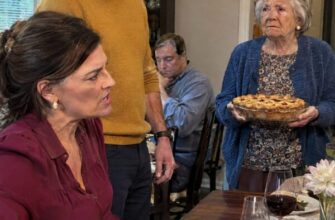
“Margaret, I think you should hear the truth before you sign anything,” the stranger said.
Richard immediately stepped between us.
“That’s enough, Tom. This is a private family matter.”
But the man shook his head.
“Not anymore.”
Vanessa lowered her eyes.
I looked from one face to another, trying to understand what was happening in my own living room.
“Who are you?” I asked the stranger.
“My name is Thomas Reed. I’m the prospective buyer’s representative. Vanessa is my sister.”
He paused before continuing.
“And I’ve been trying to get her to explain something about a payment she received three months ago.”
My heart began beating faster.
“What payment?”
Thomas looked directly at Vanessa.
“The forty-two thousand dollars.”

Richard’s face changed.
It was subtle, but I noticed it.
His jaw tightened, and his fingers closed around the edge of the folder he was holding.
“Tom, you have no idea what you’re talking about,” he said.
Thomas didn’t respond immediately.
Instead, he asked me:
“Did Vanessa tell you she was working for a medical organization?”
“Yes. She said she coordinated specialist treatment.”
Thomas closed his eyes briefly.
“Margaret, my sister has never worked for a hospital or medical organization. She used to work in property sales. She has no medical qualifications.”
I felt the room tilt around me.
I reached for the back of the sofa.

“That can’t be right.”
“I’m afraid it is.”
I turned toward Richard.
“Explain this.”
He rubbed his forehead.
“Margaret, please. You’re misunderstanding the situation.”
“What exactly am I misunderstanding? I gave her forty-two thousand dollars because you said you needed treatment.”
Richard looked at Vanessa.
She finally spoke.
“Margaret, I can explain everything.”
“Then explain it.”
She opened her mouth, but nothing came out.
Thomas placed his folder on the coffee table.
“There are some documents you should see.”
Richard immediately objected.
“You cannot start showing private financial information to my wife.”
Thomas looked at him calmly.
“Then perhaps you should explain why my sister has been receiving money from a married man while telling his wife that she was arranging medical treatment.”
I stared at Richard.
A married man.
The words seemed to hang in the air.
“Is that what this is?” I whispered.
Neither of them answered.
And somehow, their silence was worse than any confession.
I met Richard when I was 27.
He was 30, working for a commercial property maintenance company, and had a habit of making everyone laugh.
We married two years later.
Our first apartment had barely enough room for a dining table, but we were happy.
We saved for years before purchasing our house in Ohio.
When Emily was born, Richard stayed awake beside me in the hospital, holding our daughter’s tiny hand.
When Daniel arrived four years later, he cried.
I remember him whispering:
“Look at what we’ve built, Margaret.”
Those memories didn’t disappear just because he had betrayed me.
That was perhaps the most painful part.
I wasn’t looking at a stranger.
I was looking at the man who had once promised to stand beside me for the rest of our lives.
And I desperately wanted the person standing in front of me to be that man again.
But he wasn’t explaining anything.
He was watching Vanessa.
Finally, I asked:
“Richard, was there ever a medical emergency that required that money?”
He exhaled sharply.
“I had a medical problem. You know that.”
“I know you were hospitalized. I know the cardiologist recommended treatment. But did you need the forty-two thousand dollars?”
He looked away.
Thomas opened his folder.
“My sister told me something different from what you’re describing.”
Vanessa shook her head.
“Tom, don’t.”
He ignored her.
“She told me that Richard was arranging to leave his marriage and that the money was part of a private financial arrangement between them.”
I felt my knees weaken.
“What?”
Vanessa began speaking quickly.
“Margaret, it wasn’t supposed to happen this way.”
I stared at her.
“You told me my husband needed medical treatment.”
“I know.”
“You knew I was selling my jewelry?”
She didn’t answer.
“You knew I was using my savings?”
“Margaret…”
“Look at me!”
She finally raised her eyes.
“Did you know where that money came from?”
“Yes.”
That single word broke something inside me.
I turned toward Richard.
“And you?”
He remained silent.
Thomas explained that he had discovered the situation several weeks earlier.
Vanessa had approached him about helping her purchase a condominium.
She claimed she had received a private payment from a client and wanted to use it as a down payment.
Thomas worked in residential property financing and had asked her to provide documentation showing where the money had come from.
At first, Vanessa refused.
Then he discovered that the money had been transferred through an account belonging to a small consulting business she had registered several months earlier.
When he asked questions, she admitted that the payment had come from Richard’s wife.
But that wasn’t all.
Thomas had also discovered that Vanessa and Richard had been discussing purchasing a property together.
“Wait,” I interrupted. “You said a condominium?”
Thomas nodded.
“Vanessa had been looking at apartments in another part of town. She told me she was planning to move.”
I turned toward my husband.
“Were you planning to live with her?”
Richard finally spoke.
“I wasn’t planning anything until I knew what was happening with the house.”
I almost couldn’t believe what I was hearing.
“So you were going to sell our home, take your share of the money, and start another life with her?”
“It’s not that simple.”
“Then make it simple, Richard. Tell me the truth.”
He sat down.
For the first time that afternoon, he looked genuinely uncomfortable.
“I met Vanessa through work contacts about a year ago. We started talking. Things developed.”
“How long have you been seeing her?”
He hesitated.
“About eight months.”
Eight months.
I calculated the dates.
Eight months earlier, I had been celebrating his birthday.
Eight months earlier, I had been making his favorite dinner.
Eight months earlier, he had kissed me goodbye before leaving for work.
And during that same period, he had been building a relationship with another woman.
“Did you love her?” I asked.
Richard stared at the carpet.
“I thought I did.”
I nodded slowly.
Then I asked the question that mattered most.
“Was the money for your treatment?”
He rubbed his hands together.
“Margaret, the treatment was covered by insurance. There were other expenses, but…”
“But what?”
He finally admitted that Vanessa had asked him to help her financially.
He had told her that he would find a way.
When I began collecting money for his medical expenses, he realized that the situation offered an opportunity.
He had told Vanessa that I would transfer the money because I wanted him to recover.
Vanessa had provided the account details.
They had agreed that the money would help her secure a new apartment while Richard prepared to leave the marriage.
I looked at the woman.
“You watched me hand over the money.”
She began crying.
“I know. I made a terrible mistake.”
“No,” I said quietly. “You made several decisions. You created a story, sent me payment instructions, and accepted money you knew wasn’t yours.”
Vanessa wiped her face.
“I was in love with him.”
I turned toward her.
“And I was his wife.”
For a moment, nobody spoke.
Then Thomas placed another document on the table.
“There’s something else.”
Richard immediately stood up.
“Tom, stop.”
But Thomas continued.
“Vanessa told me that Richard was already discussing the sale of this house. She also said she expected to receive part of the proceeds.”
I looked at Richard.
“Part of my house?”
“It’s our house,” he replied.
“Then why was she expecting money from its sale?”
He didn’t answer.
Thomas explained that Vanessa had told him Richard intended to use his share of the proceeds to purchase a property for the two of them.
I looked at the walls around me.
The photographs.
The furniture.
The dining table where our children had celebrated birthdays.
The small wooden cabinet Richard had built when Daniel was born.
And suddenly, I understood.
He wasn’t simply leaving me.
He was trying to finance his new life with the money from the life we had built together.
I asked everyone to leave.
Thomas agreed immediately.
Vanessa gathered her handbag and folder.
Richard remained standing in the living room.
“Margaret, we need to talk.”
I looked at him.
“We’ve been talking for 28 years. Apparently, you were having a different conversation with someone else.”
He lowered his voice.
“I never wanted to hurt you.”
“Then why did you use my fear of losing you to take my savings?”
He had no answer.
Before Vanessa reached the front door, I spoke again.
“Don’t contact me about the money. Any further communication can go through my attorney.”
She turned around.
“Margaret, I’m sorry.”
I didn’t respond.
Richard remained in the house.
That evening, I slept in the guest bedroom.
I barely closed my eyes.
I kept thinking about the hospital.
The day Richard had held my hand and told me he was afraid of dying.
The day I had promised him we would get through everything together.
Had he been pretending then?
Or had he simply known that I would do anything for him?
The following morning, I called my daughter.
Emily arrived within an hour.
She found me sitting at the kitchen table with a cup of untouched coffee.
“Mom, what’s happened?”
I tried to explain everything without crying.
But when I reached the part about the forty-two thousand dollars, my voice broke.
Emily came around the table and hugged me.
“Oh, Mom.”
“I thought I was helping your father.”
“You were helping him. He was the one who chose to betray your trust.”
My son Daniel came later that afternoon.
He was furious.
He wanted to confront Richard immediately.
I asked him not to.
“This isn’t something you can fix by shouting at him,” I said. “I need to understand what happened, and I need to protect myself.”
For the first time in my life, I realized that I had to make decisions without considering what Richard wanted.
And that was both frightening and strangely liberating.
On Monday morning, I contacted an attorney.
Her name was Laura Bennett, and her office was in downtown Columbus.
I brought everything I had.
Bank statements.
The transfer confirmation.
Messages from Vanessa.
Medical bills.
Insurance explanations.
And the documents Richard had prepared for the house sale.
Laura reviewed everything carefully.
“First, don’t sign anything,” she said.
“I wasn’t planning to.”
“Good. Second, we need to establish exactly where the forty-two thousand dollars went.”
I showed her the transfer receipt.
She examined the recipient information.
“Was this money transferred to a hospital?”
“No. It went to a company account Vanessa gave me.”
“Did you receive an invoice?”
“Yes.”
“From the hospital?”
I hesitated.
“I thought it was.”
Laura looked at me.
“Margaret, these documents need to be verified independently. We shouldn’t assume the invoice is genuine.”
She contacted the hospital’s billing department with my authorization.
A few days later, we received confirmation.
The hospital had never issued the invoice Vanessa had sent me.
There was no record of the payment.
There was also no medical coordinator by that name associated with Richard’s treatment.
The hospital confirmed that the procedure Richard had undergone was billed through our insurance.
His remaining patient responsibility was substantially lower than the amount I had transferred.
I sat silently as Laura explained the findings.
“So the forty-two thousand dollars was never paid toward his treatment?”
“That’s what the available records indicate.”
I stared at the document.
I had sold my mother’s necklace.
I had withdrawn money I had saved for retirement.
I had worried about every expense because I believed my husband was fighting for his health.
And they had used that fear to deceive me.
Laura explained that we could pursue recovery of the money and that the circumstances might support claims involving fraudulent representations.
She also advised me to protect my financial accounts, preserve all messages, and avoid making any further payments.
I followed her instructions.
I changed my banking passwords.
I removed Richard’s access to my personal savings account.
I downloaded copies of every message Vanessa had sent.
And I requested copies of all the medical and insurance records.
But there was still one question I couldn’t answer.
Why had Richard announced our separation so suddenly?
What had changed?
I found the answer a week later.
And it was worse than I expected.
Laura asked me to bring every financial document I could find relating to our house.
Richard and I had purchased it 24 years earlier.
We had refinanced once, when the children were still teenagers, to pay for renovations and consolidate some debts.
I knew we still had a small mortgage balance.
What I didn’t know was that Richard had recently opened a home equity line of credit.
Laura discovered it when she reviewed the documents he had prepared for the proposed sale.
“Margaret, did you authorize this additional borrowing?”
I shook my head.
“I don’t remember signing anything.”
She showed me the paperwork.
Richard had arranged a $35,000 withdrawal against the equity in our home.
The application stated that the money would be used for home improvements.
But there had been no renovations.
No new roof.
No kitchen remodeling.
No bathroom repairs.
Nothing.
Laura explained that we needed the lender’s complete records, including the authorization documents and the destination account.
A few days later, those records arrived.
The money had been transferred into an account connected to Vanessa’s consulting business.
I read the transaction history several times.
There were two transfers.
The first was the $42,000 I had sent.
The second was the $35,000 Richard had borrowed against our home.
Together, the payments amounted to $77,000.
I had believed I was saving my husband’s life.
Instead, we had apparently been financing the beginning of his new relationship.
I felt sick.
But Laura noticed something else.
“Look at this date,” she said.
The $35,000 withdrawal had occurred only six days before Richard announced that he wanted to sell the house.
That meant he had already been preparing financially to leave.
The anniversary announcement hadn’t been a sudden decision.
It had been the final step in a plan.
I asked Laura what would happen next.
“We’ll challenge anything that was done without your authorization, seek to trace the funds, and make sure the house isn’t sold without a proper accounting of the finances. We also need to establish whether any documents were signed using your name without your knowledge.”
I nodded.
For the first time, I wasn’t simply reacting to Richard’s decisions.
I was beginning to understand them.
Richard returned home that evening and found me sorting documents into folders.
“What are you doing?”
“Organizing our financial records.”
He glanced at the papers.
“You’ve spoken to a lawyer?”
“Yes.”
His expression hardened.
“Margaret, why are you turning this into a legal battle?”
I put down the folder.
“Because you took money from our home without explaining where it was going.”
“I was going to tell you.”
“When?”
He didn’t answer.
“Before or after you moved in with Vanessa?”
He walked toward the kitchen.
“You’re making me sound like some kind of criminal.”
“I didn’t create the bank statements, Richard.”
He turned around.
“You don’t understand the pressure I was under.”
I looked at him for a long moment.
“You were under pressure?”
He nodded.
“I was unhappy. I felt trapped. I was worried about my health, about getting older, about everything. Vanessa made me feel like I still had a future.”
I let out a slow breath.
“And what about my future?”
He looked down.
“What about the years I spent working, raising our children, caring for you, and building this house? Did you ever think about what would happen to me?”
“Of course I did.”
“No. You thought about what you wanted. And when you needed money, you let me believe you were dying.”
He sat down.
“I never said I was dying.”
“You told me you were afraid of dying. You let me believe that the money was necessary for your treatment. You knew exactly why I transferred it.”
He covered his face.
For several minutes, neither of us spoke.
Then he said something I hadn’t expected.
“Vanessa told me you would understand eventually.”
I stared at him.
“Understand what?”
“That our marriage was over anyway. She said we were only delaying the inevitable.”
I shook my head.
“You didn’t need her permission to leave me, Richard. You could have told me the truth. You could have ended our marriage honestly. But you chose to deceive me and take money from me.”
He started crying.
I didn’t comfort him.
Not because I enjoyed seeing him suffer, but because I finally understood that his sadness couldn’t become my responsibility again.
The next several weeks were difficult.
Laura sent formal requests for the financial records and notified the lender that the disputed borrowing was being challenged.
She also advised me not to agree to a sale until the ownership, outstanding debt, and disputed transactions had been properly reviewed.
Thomas contacted us again.
He explained that he had withdrawn his interest in purchasing the property.
He also provided Laura with the messages Vanessa had sent him about the proposed condominium.
Those messages were important.
They showed that Vanessa had been discussing a shared future with Richard while knowing that I believed the money she received was intended for medical treatment.
Thomas had also retained documents showing that Vanessa had described the $42,000 as money she was free to use.
Laura added those records to our file.
The attorney explained that the evidence could support a civil claim to recover the money, although recovering it would depend on what assets remained and what the legal proceedings established.
We eventually learned that a substantial portion of the $42,000 had gone toward a condominium deposit and related expenses.
The money hadn’t disappeared.
It had been used to build the life Richard and Vanessa had been planning.
But their plans were beginning to fall apart.
Thomas refused to help Vanessa purchase the condominium.
The proposed sale of our house was put on hold.
And Laura made it clear that any eventual division of our marital property would have to account for the disputed financial transactions and the outstanding loan.
Richard wasn’t pleased.
He had imagined that he could simply sell the house, receive his half, and walk away.
That was no longer possible.
One afternoon, Vanessa called me.
I almost didn’t answer.
But I decided to hear what she had to say.
“Margaret, I know you probably hate me.”
“I don’t have time to discuss what I feel about you.”
“I just wanted to explain.”
“Go ahead.”
She was quiet for a moment.
Then she said:
“Richard told me your marriage was practically over. He said you had separate lives and that you were both preparing to move on.”
I closed my eyes.
“Did he tell you I was selling my jewelry to pay for his treatment?”
She didn’t answer.
“Did he tell you I was frightened every night that he might die?”
“I’m sorry.”
“Did you know that the hospital never received my money?”
There was a long silence.
Then she whispered:
“Yes.”
I gripped the phone.
“So you knew.”
“I knew later.”
“How much later?”
“Richard told me after the transfer.”
I didn’t believe her.
But I also knew that arguing with her would not change the evidence.
“Vanessa, whatever explanation you give yourself, you accepted money from a woman who believed she was saving her husband’s life. I hope you understand what that means.”
I ended the call.
I didn’t block her immediately.
I forwarded the call details to Laura and kept the records.
Then I put my phone down and went outside.
For the first time in months, I could breathe without feeling that I was waiting for another disaster.
Six months after that anniversary dinner, Richard and I signed the final divorce agreement.
It wasn’t an easy process.
The house was eventually sold after the financial issues had been addressed.
The outstanding mortgage and other properly documented obligations were paid, and the remaining proceeds were divided according to the settlement.
The disputed $42,000 and the additional borrowing were handled separately through the financial claims included in our agreement. Richard accepted responsibility for the amounts established in the settlement.
I also learned that Vanessa had ended her relationship with him.
The condominium they had planned to purchase never became their home.
Richard moved into a rented apartment.
I found a smaller house on the other side of Columbus.
It had two bedrooms, a little garden, and a kitchen with enough space for Emily and Daniel to visit with their families.
It wasn’t the house where I had raised my children.
But it was mine to arrange, decorate, and enjoy without asking anyone’s permission.
One Saturday morning, Emily came over with coffee and a box of photographs.
We sat on the living room floor, sorting through pictures from the past.
There was one of Richard holding our newborn daughter.
Another showed the four of us standing in front of our old house on the day we moved in.
Emily held that photograph for a long time.
“Mom, do you regret those 28 years?”
I looked at the picture.
For a moment, I saw the young man I had married, the children we had raised, and the life I had believed would last forever.
“No,” I finally said. “I regret the way it ended. I regret trusting someone who didn’t deserve my trust. But I don’t regret loving my children or the life we had before everything changed.”
She rested her head against my shoulder.
I smiled.
“Your father made his choices. I don’t have to spend the rest of my life paying for them.”
That evening, I made dinner for myself.
I set the table for one, opened the window, and listened to the neighbors talking in their gardens.
There was no anniversary cake.
No expensive restaurant reservation.
No grand celebration.
Just a quiet evening in a home where I finally felt safe.
A week later, Richard sent me a message.
He wrote that he was sorry, that he missed our old life, and that he sometimes wondered whether we could have worked things out if he had made different decisions.
I read it twice.
Then I put the phone down.
I didn’t hate him.
I didn’t want revenge.
But I had finally understood something that took me 28 years to learn.
Forgiving someone doesn’t mean giving them another opportunity to hurt you.
And loving someone doesn’t mean sacrificing your own security to protect them from the consequences of their choices.
I had spent months believing that I was about to lose everything.
My husband.
My home.
My savings.
My future.
But I hadn’t lost everything.
I still had my children, my memories, my independence, and the ability to begin again.
The $42,000 had been taken from me, but it hadn’t taken away my dignity.
And the house Richard wanted to sell had once been the center of my world.
Now I understood that a home wasn’t simply the walls, the mortgage, or the photographs hanging in the hallway.
It was the peace I felt when I closed the front door at night.
For the first time in 28 years, that peace belonged entirely to me.