
“Starting today, I’m living here, and you’ll do exactly what I tell you.”
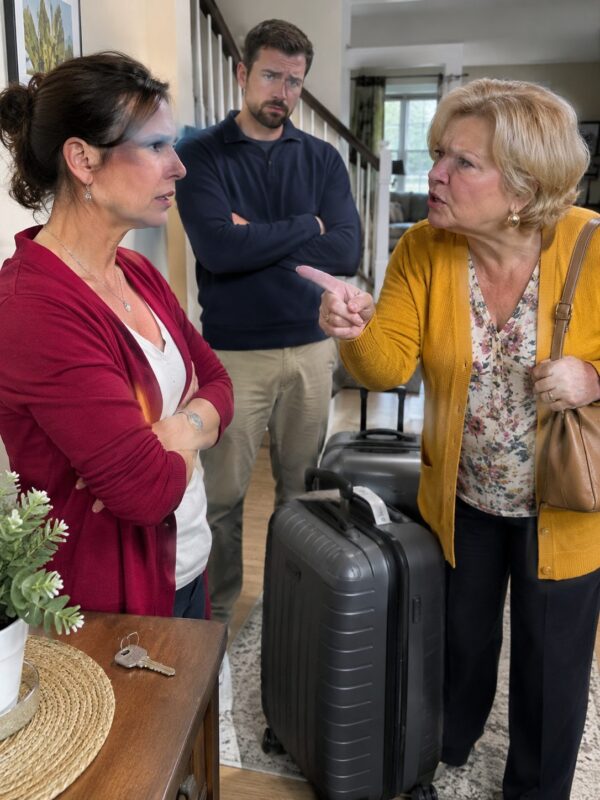
My mother-in-law, Gloria, stood in the middle of our entryway with two enormous suitcases beside her.
Her chin was raised, her lips pressed into a thin line, and her expression suggested that she had just taken command of the entire household.
I looked past her at my husband.
“Daniel, would you like to explain why your mother is standing in our house with enough luggage to stay for six months?”
He wouldn’t meet my eyes.
That was my first warning.
My second came when Gloria reached into her purse, pulled out a silver key, and placed it on the little wooden table beside our front door.
“Daniel gave me my own key,” she announced. “So we won’t have to bother you every time I come and go.”

I stared at the key.
Then at Daniel.
“You gave her a key to our house without telling me?”
“Emily, please,” he muttered. “Don’t make a scene.”
Gloria smiled.
“Your husband understands that family comes first. It’s time you learned that too.”
I was fifty-four years old. Daniel and I had been married for twenty-seven years, and until that Friday afternoon, I believed we had survived the hardest parts of our marriage.
We lived in a modest three-bedroom house outside Columbus, Ohio. The kitchen cabinets needed replacing, the backyard fence leaned slightly to one side, and the upstairs bathroom still had its original blue tiles.
But it was our home.
I worked as an administrative coordinator at a medical clinic. Daniel managed inventory for a distribution company.
We had raised two children, survived financial setbacks, and spent years working toward a mortgage-free retirement.
Our daughter, Hannah, was twenty-five and living in Cincinnati. Our son, Matthew, was finishing college.
I had finally begun imagining a quieter future.
Gloria had imagined something different.
At seventy-three, she was recently widowed, but she was not helpless. She drove herself everywhere, attended church regularly, and volunteered twice a week.
Her own house was a comfortable ranch-style property twenty minutes away.
“Why are you bringing your belongings here?” I asked.
“Because living alone no longer suits me. Daniel and I have discussed it, and we’ve decided this arrangement makes the most sense.”
“We’ve decided?”
Daniel shifted uncomfortably.
“Mom’s been lonely since Dad died.”
“I understand that. But why didn’t you discuss this with me?”
Gloria answered.
“Because Daniel knew you’d find some selfish excuse to say no.”
For twenty-seven years, she had criticized nearly every decision I made.
When our children were young, she questioned my parenting. When I returned to work, she accused me of neglecting my family.
And whenever I complained, Daniel would say, “That’s just how Mom is.”
But this time, she wasn’t criticizing my cooking.
She was moving into my house.
“Where are you planning to sleep?” I asked.
“In the large upstairs bedroom overlooking the backyard.”
My sewing room.
After decades of keeping my sewing machine in a closet, I had finally turned our spare bedroom into a small workspace. I did alterations for neighbors and earned enough extra money to help with household expenses.
“You’re not taking my sewing room.”
Gloria sighed.
“A grown woman doesn’t need an entire bedroom for a hobby.”
“It’s also my business.”
“You can move your things to the basement.”
Daniel rubbed his forehead.
“Emily, we can figure out the room later.”
“No. We need to figure out why your mother thinks she gets to decide.”
Gloria stepped closer.
“Because I am Daniel’s mother, and I refuse to spend the rest of my life asking permission to exist in my own son’s home.”
I turned to my husband.
“Did you promise her she could live here permanently?”
He hesitated.
“Yes.”
The word hurt more than I expected.
Gloria began unpacking a framed photograph of herself and her late husband.
“I’d appreciate it if someone carried these upstairs,” she said. “And starting Monday, dinner should be served at six.”
I stared at her.
“You’ve been here five minutes, and you’re already giving me orders?”
“Someone needs to bring structure into this household.”
Before I could answer, my phone rang.
It was Hannah.
I stepped into the kitchen.
“Mom,” she said immediately, “please tell me Grandma hasn’t moved in yet.”
I froze.
“How do you know?”
“Dad told me two weeks ago.”
Two weeks.
My husband had told our daughter before telling me.
But Hannah had more to say.
“Grandma called yesterday. She wanted me to convince you to sign some paperwork.”
“What paperwork?”
“She said it was about making sure Dad could keep the house if something happened to you.”
I gripped the counter.
“Hannah, are you sure?”
“Yes. She mentioned a lawyer.”
I looked through the kitchen doorway.
Gloria was whispering to Daniel.
He glanced toward me, then looked away.
I ended the call.
When I returned to the entryway, Daniel was lifting one of the suitcases.
“Put that down.”
He stopped.
I looked at Gloria.
“What paperwork have you been discussing with my daughter?”
For the first time, her confidence faltered.
Daniel slowly lowered the suitcase.
“Emily,” he said, “there’s something I should have told you.”
He reached into his jacket pocket and removed a folded envelope.
Inside was a letter from an estate-planning attorney.
The letter confirmed that Daniel had requested an appointment to discuss our home, our wills, and the possibility of transferring ownership into a trust.
I read it twice.
Then I looked up.
“Why are you consulting an attorney about our house without telling me?”
Daniel swallowed.
“Mom thought we should get everything organized.”
“Organized for what?”
Gloria folded her arms.
“Your husband has worked hard for this house. He needs to make sure his interests are protected.”
I almost laughed.
His interests?
For twenty-seven years, my salary had helped pay the mortgage, insurance, taxes, repairs, and utilities.
When Daniel lost his job eleven years earlier, I worked overtime for eight months to keep us afloat.
When the roof needed replacing, I used money I had inherited from my grandmother.
Yet Gloria was speaking as though I were a guest who had contributed nothing.
“Exactly what did you want me to sign?” I asked.
Daniel looked toward his mother.
That was when I understood something important.
He wasn’t simply afraid of upsetting her.
He had allowed her to become involved in decisions that belonged to our marriage.
“The attorney hasn’t prepared anything,” Daniel said. “It was only a consultation.”
“Then why did your mother ask Hannah to convince me?”
Gloria lifted her chin.
“Because you’re emotional about money. Someone needed to approach you sensibly.”
I placed the letter on the hallway table.
“Neither of you gets to make financial decisions for me.”
“Emily,” Daniel began.
“No. You invited your mother to move into our home. You gave her a key. You promised her my workspace. And now I discover you’ve been discussing ownership of the house.”
Gloria gave an irritated sigh.
“Honestly, Daniel, I told you she’d react this way.”
I turned to her.
“You can take your suitcases back to your car.”
Her eyes widened.
“Excuse me?”
“You’re not moving in today.”
Daniel stepped forward.
“Emily, Mom has already made arrangements.”
“What arrangements?”
Gloria answered proudly.
“I’ve sold my house.”
The room went silent.
“You sold your house?” I repeated.
“The closing is next month.”
“And where did you expect to live if I refused?”
She looked at Daniel.
“Daniel promised there wouldn’t be a problem.”
I turned toward my husband.
“Did you know she’d sold it?”
He nodded.
I felt as though the floor had shifted beneath me.
This wasn’t an impulsive visit.
They had planned everything.
And I had been the last person to know.
“Why would you sell a perfectly good house?” I asked Gloria.
Her expression hardened.
“Because I don’t need all that space. Because I’m tired of being alone. And because my son offered me a place where I could spend my remaining years.”
For the first time, I heard something beneath her anger.
Fear.
Her husband, Robert, had died eight months earlier after forty-six years of marriage.
I knew she missed him.
I had watched her sit silently through Thanksgiving dinner, staring at the empty chair beside her.
But grief didn’t give her the right to take over my life.
“Gloria,” I said, “I would have been willing to discuss ways to help you. But you didn’t ask. You decided.”
She looked away.
Daniel finally spoke.
“Can we please just sit down?”
We moved into the living room.
Gloria chose the armchair near the fireplace. Daniel sat on the couch.
I remained standing.
“I want the whole truth,” I said. “Why did you involve an attorney?”
Daniel rubbed his hands together.
“Mom was worried about what would happen if one of us died. She said we needed to review our estate documents.”
“That’s reasonable. Why keep it secret?”
He hesitated.
Then Gloria interrupted.
“Because I wanted Daniel to make sure he could remain in this house without interference from anyone else.”
“Anyone else?”
She didn’t answer.
I looked at Daniel.
“Was your mother worried about Hannah and Matthew?”
He shook his head.
“Not exactly.”
“Then who?”
His silence told me everything.
“Me,” I said.
Gloria straightened.
“Marriages don’t always last forever.”
Twenty-seven years of marriage.
And my mother-in-law was planning for the possibility that I might become inconvenient.
Daniel looked miserable.
“Mom said you might want to sell the house someday. She thought a trust could prevent disagreements.”
I took a slow breath.
“Daniel, a trust isn’t automatically a bad idea. But I should have been part of the conversation from the beginning.”
“I know.”
“No. I don’t think you do.”
I walked to the kitchen, opened a drawer, and removed the folder where I kept our mortgage statements and property documents.
I brought it back into the living room.
“Do you remember when we refinanced fifteen years ago?”
Daniel nodded.
“Do you remember whose inheritance helped us pay down the principal?”
“Yours.”
“And whose paycheck covered the mortgage while you were unemployed?”
“Yours.”
I placed the folder on the coffee table.
“Then why have you been discussing our home as though my contribution doesn’t matter?”
Daniel lowered his eyes.
Gloria stood.
“I will not sit here while you humiliate my son.”
I looked at her.
“Then perhaps you should stop asking him to humiliate his wife.”
She reached for her purse.
“Daniel, tell her this is unacceptable.”
He remained silent.
“Daniel!”
He finally looked up.
“Mom, Emily has a point.”
Gloria stared at him.
It was the first time in years I had heard him openly disagree with her.
But it wasn’t enough.
I needed to understand how far the situation had gone.
The following Monday, I took a personal day from work.
I contacted the estate-planning attorney whose name appeared on the letter.
I explained that I was Daniel’s wife and wanted to understand whether any documents affecting our jointly owned property had been prepared.
The receptionist explained that the attorney couldn’t discuss another client’s confidential communications without authorization.
That was fair.
I asked Daniel to attend a meeting with me.
He agreed.
Gloria was furious when she learned about it.
“Why do you need to involve lawyers?” she demanded over the phone. “You’re turning a simple family arrangement into a legal battle.”
“Because someone already involved a lawyer,” I replied.
At the appointment, Daniel authorized the attorney to discuss their earlier consultation.
The truth was less dramatic than I had feared, but more revealing.
No property transfer had been completed.
No trust had been created.
No document had been signed on my behalf.
However, Daniel had asked about arrangements that might allow Gloria to remain in the house if he died before her.
He had also asked how ownership might be handled if we separated.
The attorney had explained that any actual plan would depend on the property title, applicable law, and our circumstances.
Nothing had been finalized.
But Daniel had taken the first steps without me.
Outside the office, I stopped beside our car.
“Why didn’t you trust me enough to talk about this?”
He looked exhausted.
“Mom kept saying that after Dad died, she realized how quickly everything can change. She was terrified she’d lose her home, then her family.”
“So you decided to make promises you couldn’t keep?”
“Yes.”
“Why?”
He stared at the pavement.
“Because every time I told her no, she cried. She said I’d abandoned her like everyone else.”
I waited.
“And I thought if I could just get her settled, you’d eventually understand.”
I shook my head.
“You weren’t trying to solve the problem, Daniel. You were trying to avoid an uncomfortable conversation.”
He didn’t argue.
That evening, Hannah called again.
“Mom, there’s something else you should know.”
I sat down at the kitchen table.
“What is it?”
“Grandma told me she was going to give Uncle Steven part of the money from selling her house.”
Steven was Daniel’s younger brother.
He lived in Florida and had a long history of financial trouble.
“Why would she do that?”
“She said Steven needed help getting back on his feet.”
A troubling possibility occurred to me.
Gloria wasn’t merely selling her house because she wanted companionship.
She was also preparing to give away a substantial portion of the money that would otherwise support her retirement.
I called Daniel into the kitchen.
“Did your mother tell you she plans to give Steven money from the sale?”
He looked surprised.
“No.”
I showed him Hannah’s message.
For a long moment, he said nothing.
Then he picked up his phone and called Gloria.
I could hear her voice from across the table.
“That’s my private business, Daniel.”
“How much are you giving him?”
Silence.
“Mom?”
“Seventy-five thousand dollars.”
Daniel closed his eyes.
“Seventy-five thousand?”
“He needs it.”
“And you were planning to live with us permanently?”
“I told you, I don’t want to live alone.”
Daniel looked at me.
For the first time, I saw him beginning to understand the financial consequences of his promise.
His mother would sell her house, give Steven a large amount of money, and move into ours.
We would pay for groceries, utilities, maintenance, and possibly her future care.
Meanwhile, Gloria would have the authority she wanted without carrying the responsibilities that came with it.
I didn’t know whether she had deliberately planned every part of that arrangement.
But I knew I couldn’t accept it.
The next morning, Daniel asked his mother to come over.
She arrived without her suitcases this time.
She was wearing a dark green cardigan and carrying a small handbag.
“I’m assuming you’ve both come to your senses,” she said.
I gestured toward the dining table.
“Please sit down.”
Daniel sat beside me.
That alone seemed to surprise her.
He spoke first.
“Mom, we need to talk about your plans.”
Gloria frowned.
“What plans?”
“Selling your house. Giving Steven money. Moving in here.”
She waved a hand.
“I’ve already explained everything.”
“No,” Daniel said. “You’ve told us what you want. You haven’t explained how you’re going to support yourself.”
Her face tightened.
“I have savings.”
“Then we need to understand whether those savings are enough for the life you’re planning.”
“I’m not asking you for money.”
I spoke calmly.
“Living in our house would cost us money, Gloria. More importantly, it would change our daily lives. Those are things we have to discuss together.”
She looked offended.
“After everything I’ve done for this family, you’re going to charge me rent?”
“This isn’t about rent,” I said. “It’s about making decisions honestly.”
Daniel took a folded sheet of paper from the table.
We had spent the previous evening discussing what we were willing to offer.
“Mom,” he said, “we want to help you. But moving in permanently isn’t an option.”
She stared at him.
“You promised.”
“I know. And I was wrong to promise without talking to Emily.”
Her eyes filled with tears.
“So you’re choosing her over your own mother.”
Daniel’s voice trembled slightly.
“I’m choosing to respect my marriage.”
For several seconds, Gloria said nothing.
Then she looked at me.
“You’ve turned my son against me.”
I could have responded with twenty-seven years of grievances.
Instead, I said, “No, Gloria. I’m asking him to make decisions with me, not about me.”
She pushed back her chair.
“I suppose you expect me to cancel the sale.”
“That’s your decision,” I replied. “But you shouldn’t sell your home because someone promised you another home without discussing it with the person who lives there.”
She left without saying goodbye.
For three days, Daniel barely spoke.
I wondered whether he blamed me.
On Thursday evening, he came into my sewing room.
I was hemming a pair of navy trousers for a customer.
He stood in the doorway for a moment.
“I’m sorry,” he said.
I stopped sewing.
“For what?”
“For giving Mom the key. For making promises. For thinking you’d just accept whatever I decided.”
I waited.
“And for making you feel like a stranger in your own home.”
That was the apology I had needed.
Not an excuse.
Not another reminder that his mother was difficult.
An acknowledgment that he had betrayed my trust.
“I love your mother,” I said. “I know she’s grieving. But I won’t spend the rest of my life being treated as though my needs don’t matter.”
He nodded.
“I understand.”
I wanted to believe him.
But after twenty-seven years, I knew that words alone wouldn’t change old habits.
So we made practical changes.
Daniel collected the extra house key from Gloria.
We agreed that neither of us would invite anyone to live with us without the other’s consent.
We scheduled an appointment with an estate-planning attorney together to review our wills and discuss our future.
And we began meeting with a marriage counselor.
Not because our marriage was over.
Because I wanted to know whether we could finally build one in which both people had an equal voice.
Two weeks later, Gloria called.
Her voice sounded different.
Less commanding.
More tired.
“Emily, may I ask you something?”
“Of course.”
“Would you come with me to look at an apartment?”
I was surprised.
“What apartment?”
“There’s a senior apartment community about ten minutes from your house. One of the women from church lives there. She says they have activities, a walking group, and a little garden.”
“What happened to selling your house?”
“I’m still considering it. But I’ve postponed the closing while I work out what I can afford.”
I hesitated.
“And Steven?”
She sighed.
“I told him I couldn’t give him seventy-five thousand dollars.”
“How did he take that?”
“Badly.”
There was a long pause.
Then she added, “Perhaps I should have thought about my own future first.”
It was the closest thing to an admission of error I had ever heard from her.
I agreed to accompany her.
The apartment was bright, with a small balcony overlooking a courtyard.
Gloria walked slowly from room to room.
In the kitchen, she opened the cabinets and inspected the shelves.
Then she stood beside the window.
“Robert would have liked this,” she said softly.
I looked at her.
She hadn’t mentioned her husband by name in weeks.
“He always wanted a place with less yard work,” she continued. “I kept telling him we were too young to downsize.”
Her eyes filled.
“Then suddenly he was gone.”
I stood quietly beside her.
For the first time, I understood that her determination to control my home was partly an attempt to escape the emptiness of her own.
It didn’t excuse what she’d done.
But it helped me see the frightened woman beneath the demands.
“I don’t want to be alone, Emily,” she whispered.
“You don’t have to be alone,” I said. “But being close to family doesn’t mean taking over their lives.”
She nodded slowly.
A month later, Gloria moved into a two-bedroom apartment in the same community.
She had worked with a financial adviser to review the proceeds of her house sale, her savings, and her expected expenses before making the commitment.
Steven was unhappy about the money.
Daniel supported his mother’s decision to protect her own financial security.
For once, he didn’t try to solve his brother’s problems by making promises on someone else’s behalf.
Gloria still visited us.
She still had opinions about my cooking, my curtains, and the amount of time I spent sewing.
But something had changed.
She knocked before entering.
She asked before offering advice.
And when I said no, she was beginning to accept that it was a complete answer.
One Sunday afternoon, she came for dinner.
After we ate, she wandered upstairs and stopped at the door of my sewing room.
I was finishing a quilt made from pieces of old family clothing.
She studied the fabric.
“Is that Robert’s blue shirt?”
I nodded.
“I saved a few pieces after you gave us his clothes. I thought you might like something made from them.”
She touched the quilt gently.
For a moment, her face crumpled.
“You made this for me?”
“Yes.”
She sat in the chair beside my cutting table.
“I wasn’t very kind to you when I came here with those suitcases.”
“No,” I said. “You weren’t.”
She looked down.
“I was frightened. And angry. I thought if I could make everything happen the way I wanted, I wouldn’t have to feel so helpless.”
I said nothing.
Then she looked up.
“I shouldn’t have treated you that way.”
It wasn’t a perfect apology.
But it was real.
I handed her the quilt.
She held it against her chest and began to cry.
That evening, after Gloria went home, Daniel found me standing in the entryway.
The little wooden table was empty.
No unfamiliar key.
No suitcases.
No one issuing orders.
He slipped his hand into mine.
“Thank you for giving Mom another chance,” he said.
“I didn’t give her my home,” I replied. “I gave her a chance to be part of our lives without taking them over.”
He nodded.
And as I turned off the hallway light, I realized something I wish I had understood years earlier.
A peaceful family isn’t one where nobody ever says no.
It’s one where love doesn’t require someone to surrender their dignity.
Gloria had arrived believing she could command my household.
But in the end, the most important thing we all learned was that a home isn’t made stronger by one person controlling everyone inside it.
It’s made stronger when everyone who belongs there is treated with respect.