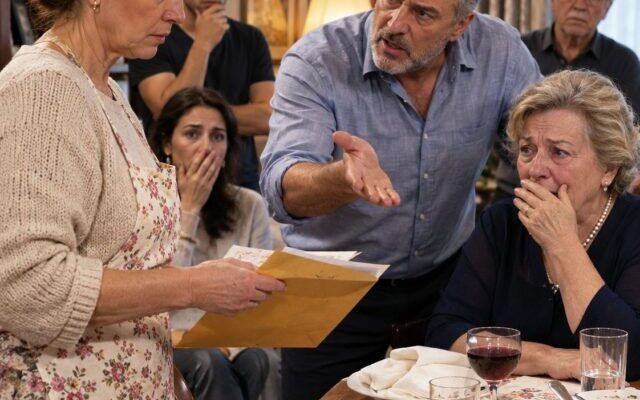
Twelve people fell silent at once.
His mother, Ingrid, sat at the other end of the table, holding a crumpled tissue against her eyes.
I stood beside the stove, still wearing my apron.
I had been cooking for six hours.
And now I was being called a thief in front of the entire family.
“Thomas,” I said calmly, “are you sure you want to discuss this in front of everyone?”
“Yes!” he replied. “Everyone deserves to know what you’ve done to my mother!”
I looked at my mother-in-law.
She lowered her head.
But I noticed something nobody else did.
Under the table, she was gripping her handbag so tightly that her knuckles had turned white.
At that moment, I knew the evening would end very differently from the way she had planned.
But I need to start from the beginning.

My name is Sabine. I’m fifty-four years old, and I’ve been married to Thomas for twenty-eight years.
We live in a terraced house on the outskirts of Leipzig.
Our two children are grown up. Our daughter, Laura, works in Dresden, and our son, Felix, lives in Halle with his girlfriend.
Thomas is a master electrician. I’ve worked in the accounting department of a medium-sized company for sixteen years.
We never had much money.
But we had enough.
Or at least, that’s what I thought.
Nine months ago, my father-in-law, Heinrich, passed away.
He had been a quiet man who preferred working in his garden to getting involved in family affairs.
His wife, Ingrid, was the complete opposite.
She had an opinion about everything.
And, in her eyes, hers was usually the only opinion that mattered.
After Heinrich’s funeral, she began calling us almost every day.
“I can’t sleep at night,” she would say.
“The house feels so empty.”
“Sometimes I’m afraid to walk down the stairs alone.”
Thomas was worried.
One evening, he said:
“Maybe Mom should come and stay with us for a while.”
I wasn’t enthusiastic about the idea.
But I knew she was grieving.
“For a few weeks,” I replied. “Until she gets some strength back.”
Three days later, she showed up at our front door with four large suitcases.
Four suitcases.
For a few weeks.
I should have been more suspicious back then.
At first, everything was relatively peaceful.
I made her coffee every morning, accompanied her to doctor’s appointments, and did her shopping.
But before long, Ingrid began interfering in our daily lives.
The curtains were supposedly too dark.
The food was too salty.
The towels were in the wrong cupboard.
And every evening, Thomas received a detailed list of my supposed shortcomings.
“Sabine doesn’t mean any harm,” she would say in a sad voice. “But sometimes I feel as though I’m in the way here.”
Thomas always replied:
“Mom, you’re not in the way.”
Then he would look at me.
And I knew exactly what that look meant.
I was supposed to try harder.
One morning, Ingrid asked me if I could accompany her to the bank.
She wanted to pay some bills.
I drove her downtown, waited outside, and then brought her home.
Two weeks later, money supposedly disappeared from her bank account.
At first, it was five hundred euros.
Then two thousand.
Finally, she claimed that a total of eight thousand euros had gone missing.
Thomas was horrified.
“How could something like this happen?”
Ingrid shook her head.
“I don’t know. I’m just an old woman.”
Then she added:
“Sabine was the only one who accompanied me to the bank.”
I looked at her.
“What exactly are you implying?”
“Nothing, dear. I’m just saying what happened.”
Thomas remained silent.
That silence hurt more than any accusation.
The next day, he asked me whether I had used his mother’s bank card.
At first, I thought he was making a bad joke.
“Of course not.”
“Mom says you know her PIN.”
“I don’t know her PIN.”
“She claims otherwise.”
I put down my coffee cup.
“Thomas, are you seriously asking me whether I stole from your mother?”
He avoided my eyes.
“I’m just trying to figure out what happened.”
Over the following weeks, our home became unbearable.
Ingrid would go quiet whenever I entered a room.
Thomas suddenly started checking our joint bank statements.
Once, he even asked why I had withdrawn two hundred euros in cash.
“To pay for the washing machine repair,” I replied. “The receipt is on the desk.”
He didn’t apologize.
He simply nodded.
That’s when I realized my marriage had changed.
Not because of the money.
But because my husband was willing to believe everything his mother said and nothing I said.
Then something unexpected happened.
One Thursday, my sister-in-law, Petra, called me.
Petra was Thomas’s younger sister. She lived with her husband in Magdeburg.
We had never been particularly close.
So her call surprised me.
“Sabine, can you promise me something?”
“What?”
“Don’t tell Mom I spoke to you.”
I sat down.
“What happened?”
Petra was silent for a few seconds.
Then she asked:
“Has Mom also claimed that money has disappeared while she’s been staying with you?”
My heart began beating faster.
“How do you know about that?”
“Because she tried exactly the same thing with me three years ago.”
I said nothing.
Petra told me that her mother had withdrawn several thousand euros from her bank account back then.
Afterward, she had accused Petra’s husband.
The family had argued for months.
Only later did they discover that Ingrid had given the money herself to an acquaintance who had supposedly offered her an especially safe investment opportunity.
The money had disappeared.
But Ingrid had never apologized.
“Why didn’t you tell Thomas?” I asked.
Petra laughed bitterly.
“I tried. He said I was just trying to make Mom look bad.”
Then her voice became quieter.
“Sabine, be careful. Mom told me yesterday that she would make sure Thomas finally realized what kind of woman you are.”
After that phone call, I sat at the kitchen table for a long time.
I was angry.
But my disappointment was even stronger.
The next morning, I began organizing my documents.
Not to get revenge on Ingrid.
But because I was no longer willing to let someone control my life with made-up stories.
I gathered bank statements, receipts, and messages.
Then I remembered something.
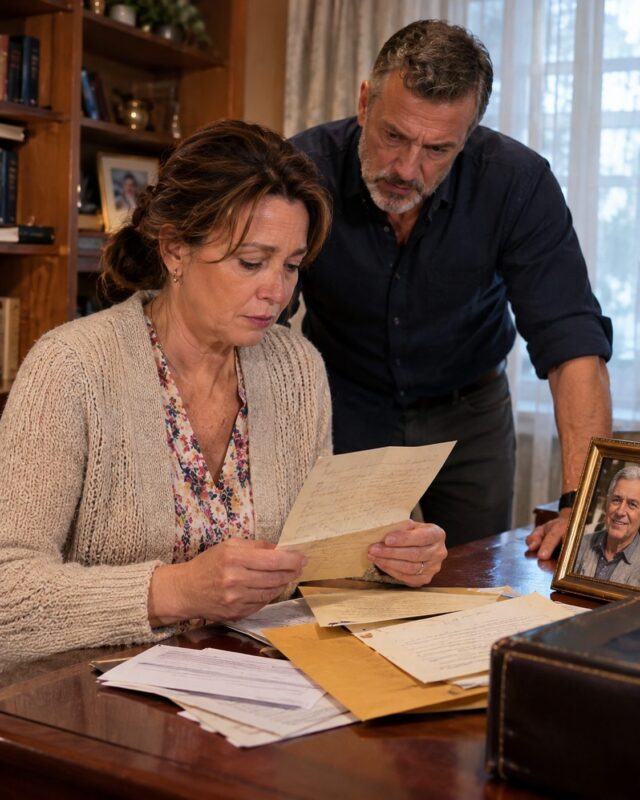
Three weeks before his death, Heinrich had given me an envelope.
We had been alone in the kitchen.
He looked tired.
“Sabine,” he said, “I want you to keep this somewhere safe.”
“What is it?”
“Some documents. You might need them someday.”
I had looked at him in confusion.
“Why don’t you give them to Thomas?”
Heinrich had been silent for a long time.
“Because Thomas never contradicts his mother.”
I hadn’t understood his words back then.
The envelope had been lying in the back of my desk drawer for months.
I had never opened it.
Now I did.
Inside were several copies of bank transfer receipts, a handwritten list, and a letter.
The letter was addressed to Thomas and Petra.
Heinrich wrote that Ingrid had repeatedly transferred money to a man named Ralf Berger over the past few years.
She had claimed it was a private investment.
But Heinrich had discovered that Berger had been taking money from her for years.
In total, she had given him more than forty thousand euros.
Heinrich had tried to stop her.
But it was no use.
Then I read the final paragraph.
“If Ingrid ever claims that someone in the family has taken her money, check the documents first. I have seen too many times how she blames others out of shame.”
I felt a chill run down my spine.
I placed the letter on the table.
Suddenly, I understood why Heinrich had given it to me specifically.
He knew that one day, someone would need proof.
Still, I didn’t want to jump to conclusions.
The documents proved that she had made previous transfers, but they didn’t yet establish what had happened to the supposedly missing eight thousand euros.
So I spoke to Petra.
She immediately recognized the name Ralf Berger.
“That man is still in contact with Mom,” she said.
“How do you know?”
“I saw them together in a café two months ago.”
That same evening, I asked Ingrid a simple question.
“Do you know someone named Ralf Berger?”
Her hand stopped above the sugar bowl.
Just for a moment.
Then she replied:
“No. Why?”
“Just curious.”
She stood up and left the kitchen.
Ten minutes later, I heard her talking to Thomas on the phone.
“Your wife is asking me strange questions,” she said.
The next day, Thomas announced that he would invite the entire family over on Sunday.
“We need to clear things up once and for all.”
I asked:
“What exactly needs clearing up?”
“Mom wants everyone to know what happened.”
“And what do you want?”
He didn’t answer.
On Sunday, Petra and her husband arrived, along with our two children, Thomas’s uncle Klaus, and several other relatives.
I had prepared roast beef with potato dumplings.
There was also red cabbage and a large salad.
For dessert, I had made apple cake.
Ingrid wore a dark blue blouse and her pearl necklace.
She seemed surprisingly pleased with herself.
During dinner, she talked about her sleepless nights and how difficult life had become since Heinrich’s death.
Everyone listened attentively.
Then Thomas placed his napkin on the table.
“There’s something we need to talk about.”
I knew what was coming.
He stood up.
“Mom has lost a lot of money over the past few months.”
Petra looked at me.
I remained silent.
“And there are reasons to believe that Sabine has something to do with it.”
Laura dropped her fork.
“Dad, what are you talking about?”
“I just want your mother to finally tell the truth.”
I looked at my husband.
Twenty-eight years of marriage.
Two children.
A life built together.
And he hadn’t even had the decency to speak to me privately first.
“Thomas,” I asked, “do you have a single piece of evidence?”
“Mom told me.”
“That’s not what I asked.”
Ingrid began to cry.
“I never wanted an argument.”
Petra shook her head.
“Mom, please. Not again.”
Thomas turned toward her.
“What is that supposed to mean?”
“You know exactly what I mean.”
I stood up.
“Just a moment.”
Then I walked into the study and retrieved the old envelope.
When I returned, Ingrid noticed it immediately.
All the color drained from her face.
“Where did you get that?” she whispered.
“From Heinrich.”
She stared at me.
“That can’t be.”
“Yes, it can. He gave it to me shortly before he died.”
Thomas reached out his hand.
“What is that?”
I placed the envelope in front of him.
“Read it.”
He opened it.
At first, he skimmed through the documents.
Then he picked up his father’s letter.
As he read, his expression changed.
His forehead furrowed.
His hands began to tremble.
Finally, he looked at his mother.
“Mom, who is Ralf Berger?”
Ingrid said nothing.
“Mom?”
“An old acquaintance.”
“Why did you transfer so much money to him?”
“That’s none of your business.”
Petra leaned forward.
“It is our business, Mom. Especially when you’re accusing Sabine of stealing it.”
Thomas turned another page.
“Forty thousand euros?”
Nobody said a word.
Ingrid began crying again.
“Your father never understood how lonely I was.”
Thomas closed his eyes.
“Did this man also receive the eight thousand euros?”
She didn’t answer.
I said calmly:
“Only the latest bank statements can confirm that.”
Ingrid glanced at her handbag.
Then at Thomas.
And suddenly, she said something nobody expected.
“I gave him the money. But I wanted to get it back before any of you found out.”
Laura covered her mouth with her hand.
Thomas stared at his mother.
“And that’s why you accused Sabine?”
“I was afraid you would think I was stupid.”
“So my wife had to become a thief instead?”
Ingrid lowered her head.
Then she whispered:
“I thought she would somehow be able to put up with it.”
Those words were worse than anything else.
She would somehow be able to put up with it.
The humiliation.
The accusations.
The distrust of my own husband.
All of it, just so Ingrid wouldn’t have to feel ashamed.
Petra stood up.
“I can’t do this anymore.”
Her husband followed her.
Uncle Klaus sadly shook his head.
“Heinrich once told me he was afraid something exactly like this would happen.”
Thomas looked at him.
“You knew about this?”
“Not everything. But enough to understand why he was worried.”
Our daughter, Laura, picked up her jacket.
“Mom, do you want to come with me?”
I shook my head.
“Not yet.”
Felix stood up too.
“Dad, you should be ashamed of yourself.”
Thomas said nothing.
Within minutes, everyone had left the house.
Only Ingrid, Thomas, and I remained at the table.
The apple cake was untouched in the kitchen.
Ingrid wiped away her tears.
“Sabine, I never wanted things to go this far.”
I looked at her.
“You wanted your son to accuse me in front of the entire family.”
She remained silent.
“You knew I was innocent.”
No answer.
“And you still watched it happen.”
Thomas placed his father’s letter on the table.
“Mom, you can’t stay with us anymore.”
Ingrid looked at him in horror.
“Are you throwing your own mother out?”
“No. I’m saying we need to find another arrangement. But Sabine will no longer have to pay for your decisions.”
For the first time in many years, Thomas stood up to his mother.
But for me, that moment came far too late for me to feel simply relieved.
The next morning, Ingrid went to stay with Petra.
The two of them agreed to review her financial affairs together.
Later, the bank statements confirmed that Ingrid had indeed transferred the eight thousand euros to Berger herself, in several installments.
Petra helped her secure the documents and seek advice about the possibility of fraudulent investment promises.
I didn’t get involved.
Not out of spite.
But because I had finally understood that I wasn’t responsible for solving every problem in that family.
Thomas tried to talk to me.
At first, every evening.
Then every morning.
He brought me flowers.
He cooked.
He apologized.
But I couldn’t simply accept his words.
One evening, he asked:
“What can I do to make you trust me again?”
I replied:
“You first need to understand why I no longer trust you.”
He sat down.
And this time, he listened.
I told him about the months when I had felt like a defendant in my own home.
About his questions.
About his looks.
About his silence.
And about that Sunday when he had publicly accused me in front of our children.
He didn’t interrupt me once.
When I finished, he said:
“I let you down.”
For the first time, his apology didn’t sound like an excuse.
Still, I needed some distance.
I moved into a small furnished apartment for six weeks.
Thomas began seeking professional help to understand why he had never been able to set boundaries with his mother.
We occasionally met for coffee.
Sometimes we talked.
Sometimes we simply sat there in silence.
Three months later, I moved back home.
Not because everything had been forgotten.
But because I wanted to see whether we could learn to trust each other again.
Ingrid now lives in her own apartment.
We only see each other at larger family gatherings.
She apologized to me once.
“I made a terrible mistake,” she said.
I replied:
“You made a choice. And I had to live with the consequences.”
I said nothing more.
The old envelope is still in my desk today.
Sometimes I think about Heinrich.
About the quiet man who preferred pruning roses to getting involved in arguments.
And about his final words:
“You might need these documents someday.”
He was right.
But the most important truth wasn’t written in his letter.
I only learned it that Sunday, when my husband called me a thief in front of twelve people.
A marriage doesn’t always fall apart because of one enormous betrayal.
Sometimes it begins to crumble when the person who should know you best doesn’t even ask whether an accusation is true.
And trust doesn’t return simply because the truth finally comes out.
It only returns when someone is willing to take responsibility for the fact that they didn’t believe you.