“There’s no place for your mother at this table. She can eat at her own house.”
My wife said it while eight guests sat around our dining table, waiting for dinner.
My seventy-nine-year-old mother, Margaret, was standing just inside the doorway with a homemade apple pie in her hands.
For a moment, I honestly thought I’d misheard.
“Lauren,” I said, “what did you just say?”
She straightened the napkin beside her plate.
“You heard me, Michael. I planned this dinner for our friends. Your mother wasn’t invited.”
The room went silent.
Mom looked down at the pie.
“I only came because Michael said it would be all right.”
Lauren sighed.
“And Michael should have asked me first.”

I watched my mother set the glass dish on the sideboard. Her fingers moved carefully, as though she were afraid of making a noise.
She had baked that pie because she remembered Lauren loved cinnamon apples.
I knew because she’d called me that morning to ask whether we still kept vanilla ice cream in the freezer.
Now she stood in her best blue cardigan, looking as though she’d walked into the wrong house.
“Mom, get your coat,” I said. “We’re leaving.”
I was already reaching for my car keys when she caught my hand.
“Wait, Michael.”
“Mom, you don’t have to stay here.”
“I know.”
She looked at Lauren.
“But I think it’s time we settled something.”
Then she opened her handbag.
What happened next changed the way I understood the previous twenty years of my marriage.
My name is Michael Bennett. I’m fifty-two, and I own a small electrical contracting business in Columbus, Ohio.
Lauren and I married twenty-three years ago. We have two daughters, Emily and Sarah, both grown now.
We live in a four-bedroom house in a quiet suburban neighborhood. There’s a maple tree beside the driveway and a wooden deck I built myself.
From the outside, we probably look like an ordinary middle-class family.
For years, I believed we were happy.
Lauren worked as an office administrator for a dental practice. She was organized, practical, and particular about how things were done.
When our daughters were small, she handled school schedules, medical appointments, and most of the household finances.
I worked long days, sometimes six days a week.
We argued occasionally, but I thought our marriage was solid.
My mother had always been part of our lives.
She raised me after my father died of a heart attack when I was eleven.
She worked at a hospital cafeteria in the mornings and cleaned offices at night.
Some evenings, she’d come home so exhausted she could barely take off her shoes.
Yet she always asked about my homework.
When I turned sixteen, she helped me buy a used truck by saving small amounts from every paycheck.
She taught me how to change a tire, balance a checkbook, and treat people respectfully.
“Michael,” she used to say, “you can lose money and earn it again. But once you make someone feel worthless, it’s hard to take that feeling away.”
I remembered those words that Saturday evening.
Because my wife had just made my mother feel worthless in front of a room full of people.
The trouble between them hadn’t started that night.
It had been building for years.
When Lauren and I first married, Mom helped us whenever she could.
She watched Emily while Lauren finished a certification program. She brought groceries when my business was struggling. She sewed curtains for our first apartment.
Lauren thanked her politely.
But after we bought our house, something changed.
Mom would offer to help with dinner, and Lauren would tell her the kitchen was already organized.
She’d bring a casserole, and Lauren would complain that there wasn’t room in the refrigerator.
When Mom called, Lauren sometimes rolled her eyes before handing me the phone.
I dismissed these things as personality differences.
Mom was affectionate and informal.
Lauren liked schedules and boundaries.
I told myself neither woman was wrong.
Three years ago, Mom suffered a minor stroke.
Fortunately, she recovered without major physical limitations, but her doctor recommended that she stop driving at night.
I began visiting more frequently.
Sometimes I brought her groceries. Sometimes we had Sunday lunch together.
Lauren grew increasingly irritated.
“Your mother has neighbors,” she told me once. “She doesn’t need you every weekend.”
“She’s seventy-six, Lauren.”
“And she’s perfectly capable of looking after herself.”
Mom was capable.
That was never the point.
I wanted to spend time with her while I still could.
Then came the dinner.
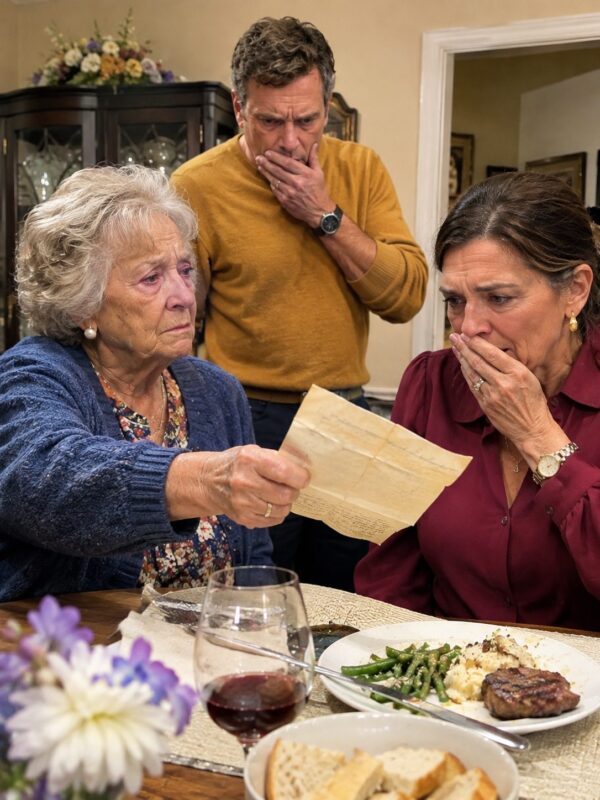
Lauren had invited several friends, including her younger sister Denise and Denise’s husband, Paul.
She’d spent the afternoon preparing everything.
There were fresh flowers on the table, polished glasses, and a carefully arranged platter of appetizers.
Mom arrived at six thirty.
When I opened the door, she smiled and lifted the pie.
“Still warm.”
I kissed her cheek.
“Come in.”
Lauren appeared from the dining room.
Her expression immediately hardened.
“What is she doing here?”
“She’s having dinner with us.”
“No, Michael. She’s not.”
I laughed awkwardly.
“Come on. I’ll get another chair.”
But Lauren followed me into the dining room and removed the extra place setting.
“We have enough seats for the people I invited.”
I brought in a chair from the kitchen anyway.
She pushed it against the wall.
Then she made her announcement.
“There’s no place for your mother at this table. She can eat at her own house.”
Denise stared into her lap.
Paul cleared his throat.
One of our neighbors, Karen, quietly put down her fork.
Nobody defended Mom.
And I was ashamed that I had allowed things to reach this point.
“Get your coat, Mom,” I said.
But she caught my wrist.
“Wait.”
She sat down slowly and opened her handbag.
Lauren folded her arms.
“Margaret, please don’t make a scene.”
Mom looked at her.
“I’m not the one who made a scene, dear.”
She took out a cream-colored envelope.
It was yellowed around the edges and protected by a transparent plastic sleeve.
Across the front was my name.
Michael Bennett.
I recognized the handwriting immediately.
It belonged to Lauren’s father, Robert Whitman.
Robert had died six years earlier.
He’d been a quiet, hardworking man who spent most of his career managing a warehouse outside Columbus.
I respected him.
More than that, I believed he had saved our family from financial disaster.
Twenty years earlier, my contracting business had nearly collapsed.
A commercial customer had gone bankrupt owing me thousands of dollars. I still had employees to pay and suppliers demanding payment.
We were behind on our mortgage.
Emily was two, and Sarah had just been born.
I remember sitting at the kitchen table one night with overdue notices spread in front of me.
Lauren found me there.
“How bad is it?” she asked.
“Bad enough that we could lose the house.”
She said she’d talk to her father.
A week later, she told me Robert had agreed to lend us thirty-eight thousand dollars.
I couldn’t believe his generosity.
I offered to sign a formal repayment agreement.
Lauren said her father didn’t want paperwork between family members.
“He trusts us,” she explained.
The money arrived in our account shortly afterward.
I used it to catch up on the mortgage, pay suppliers, and keep the business running.
Over the following seven years, I repaid the entire amount through monthly checks made out to Robert.
Lauren handled the correspondence.
Whenever I thanked Robert, he’d smile and change the subject.
I assumed he was simply modest.
Now, twenty years later, my mother was holding a letter he’d written during that crisis.
“Mom,” I asked, “what is that?”
She looked at Lauren.
“Do you remember the winter Michael nearly lost this house?”
Lauren’s face changed.
“Margaret, don’t.”
“Do you remember what your father told you?”
“This is none of your business.”
Mom’s voice remained calm.
“I think it became my business a long time ago.”
She removed the letter from its sleeve.
“Michael, there’s something you deserve to know.”
Lauren stood abruptly.
“Give me that.”
Mom placed the paper beside Lauren’s plate.
Lauren looked down.
Her eyes moved toward the bottom.
Then her hands began trembling.
I leaned forward.
There were two signatures.
Robert Whitman.
And Margaret Bennett.
“What is this?” I asked.
Mom nodded toward the paper.
“Read it.”
Lauren grabbed my wrist.
“Michael, please. Not in front of everyone.”
I looked at her.
“Then why did you humiliate my mother in front of everyone?”
She released my arm.
I picked up the letter.
It was dated February 14, twenty years earlier.
Robert had written it in plain, careful language.
He confirmed that my mother had given him thirty-eight thousand dollars to pass along to Lauren and me during our financial crisis.
The money had come from the sale of a small parcel of land Mom inherited from her parents.
Robert explained that Margaret wanted to help us without embarrassing me.
He agreed to present the money as his own loan because Mom believed I’d refuse to accept her savings.
Then I reached the final paragraph.
Robert wrote that any money I repaid was to be returned to Margaret.
He and Mom had both signed the letter to document their understanding.
I read it twice.
Then a third time.
My mouth went dry.
“Mom,” I said, “you sold Grandpa’s land?”
She nodded.
“I wasn’t using it, Michael.”
“That was your retirement money.”
“I had my pension. You had two little girls and a mortgage.”
I looked at Lauren.
“You told me your father lent us the money.”
She didn’t answer.
“And I paid him back.”
“Yes,” she whispered.
“Every dollar?”
“Yes.”
I stared at the letter.
“Then why didn’t you tell me it came from Mom?”
Lauren looked toward our guests.
“Can we please discuss this privately?”
Mom spoke before I could answer.
“There’s another part, Michael.”
She reached into her handbag again.
This time she produced a small folder containing copies of bank records and several handwritten notes.
I recognized Robert’s handwriting on the first page.
“Your father-in-law called me about a year after you finished paying him back,” Mom explained. “He wanted to make sure I’d received the money.”
I frowned.
“Hadn’t you?”
Mom shook her head.
“No.”
Lauren closed her eyes.
I turned toward her.
“Where did the money go?”
She whispered, “Michael, it wasn’t that simple.”
“Thirty-eight thousand dollars isn’t complicated.”
“Please don’t do this here.”
I looked around the table.
Our guests sat frozen.
Karen’s husband was staring at his plate. Denise had tears in her eyes.
I took a breath.
“Everyone, I’m sorry. Dinner is over. We need some privacy.”
No one argued.
Coats were collected quietly.
Denise paused beside Lauren.
“Call me tomorrow,” she said.
Within minutes, the front door closed behind the last guest.
The three of us remained in the dining room.
Mom sat with her hands folded in her lap.
Lauren stood near the window.
I put the letter on the table.
“Start talking.”
Lauren rubbed her forehead.
“When Dad agreed to help us, he told me about your mother’s money. I didn’t want you to feel ashamed.”
“That explains the first lie,” I said. “What about the repayments?”
She hesitated.
“I was going to tell you.”
“When?”
“I don’t know.”
“Lauren.”
She sat down.
“Dad returned the money to me after you finished paying him back.”
My stomach tightened.
“He returned it to you?”
She nodded.
“He told me to give it to your mother.”
“And you didn’t.”
“No.”
I waited.
Lauren stared at her wedding ring.
“At the time, I was helping Denise.”
I blinked.
“Your sister?”
“She’d separated from her first husband. She was behind on rent. She had credit card debt. She was frightened she’d lose her apartment.”
“So you gave her my mother’s money?”
“Not all at once.”
I couldn’t speak.
Lauren continued.
“I gave her some for the rent. Then I paid off two credit cards. Later, she needed help replacing her car.”
“How much?”
She swallowed.
“Most of it.”
I pushed my chair back.
For twenty years, I’d believed Robert Whitman had rescued our family.
For thirteen years, my wife had concealed the fact that my mother was owed the money I’d repaid.
And now I was learning she’d spent nearly all of it on her sister.
“Did Denise know where it came from?”
Lauren shook her head.
“She thought it was money Dad had given me.”
I looked at Mom.
“Why didn’t Robert tell me?”
“He wanted to,” she said. “But he felt responsible for agreeing to the arrangement in the first place.”
She pointed toward the folder.
“He kept copies of everything. He told Lauren to put it right.”
Lauren’s eyes filled with tears.
“I was going to replace it.”
“With what?”
“Our savings. Eventually.”
I thought about our finances.
We had retirement accounts, a modest emergency fund, and some equity in the house.
But we also had college expenses and business costs.
There had been opportunities over the years to put money aside for Mom.
Instead, Lauren had repeatedly complained whenever I bought her groceries or paid for a home repair.
I remembered an argument from the previous Christmas.
I’d spent eight hundred dollars replacing Mom’s broken furnace motor.
Lauren had been furious.
“Your mother needs to stop treating you like an ATM.”
Now I understood how cruel those words had been.
“Does she know?” I asked Mom.
“Know what?”
“That Lauren never returned your money.”
Mom nodded.
“Robert told me before he died.”
I stared at her.
“That was six years ago.”
“Yes.”
“Why didn’t you say anything?”
She looked down at her hands.
“Because your daughters were still living at home. Because you were working so hard. And because I hoped Lauren would eventually do the right thing.”
I sat beside her.
“Mom, you should have told me.”
“Perhaps I should have.”
She touched my hand.
“But I didn’t want money to destroy your marriage.”
I looked across the room at Lauren.
“And tonight?”
Mom’s expression changed.
“Tonight wasn’t about money.”
She glanced toward the empty chair.
“I could live without those savings, Michael. I’ve managed. But I couldn’t keep sitting quietly while someone treated me as though I were an embarrassment.”
Lauren began crying.
“Margaret, I never meant—”
Mom raised a hand.
“Please let me finish.”
Lauren fell silent.
“I’ve never asked to live here. I’ve never asked you to pay my bills. I bring food because I like cooking for my family. I call because I love my son.”
Her voice shook slightly.
“I don’t expect to be the center of your lives. But I do expect to be treated like a person.”
For the first time that evening, Lauren had no answer.
I walked into the kitchen.
The steaks were cooling on the counter.
The potatoes had gone soft.
On the sideboard sat Mom’s apple pie, still untouched.
I brought it to the table.
“Mom, would you like some?”
She gave a small, tired smile.
“After all that trouble, I suppose we shouldn’t waste it.”
I cut three slices.
Lauren didn’t touch hers.
We sat quietly for several minutes.
Then I asked my wife a question.
“Why have you been so determined to keep Mom away?”
Lauren stared at the table.
“I was afraid she’d tell you.”
“Tell me what?”
“About the money. About Denise. About everything.”
She wiped her face.
“Every time she came over, I thought she might finally say something. And I knew that if you found out, you’d never trust me again.”
I thought about that.
For years, Lauren had made my mother seem intrusive and demanding.
She’d turned ordinary visits into arguments.
She’d convinced me that Mom was interfering with our marriage.
But the real problem wasn’t Mom’s presence.
It was Lauren’s fear of being exposed.
“Instead of admitting what you’d done,” I said, “you tried to make me resent the person you owed.”
Lauren covered her face.
“I know.”
The next morning, I drove Mom home.
Her house was a small two-bedroom ranch with a narrow front porch and flowerpots beside the steps.
She’d lived there for almost forty years.
Inside, everything was familiar.
The old kitchen clock.
The yellow curtains.
The photograph of my father beside the telephone.
Mom put on a pot of coffee.
“Michael,” she said, “I don’t want you making decisions out of anger.”
I sat across from her.
“I’m not angry about the money alone.”
“I know.”
“I’m angry because I let Lauren treat you badly.”
Mom reached across the table.
“You didn’t know everything.”
“I knew enough.”
She didn’t argue.
I looked around her kitchen.
The refrigerator was old. The cabinets needed painting. A section of the floor near the sink had started to lift.
She’d been living carefully for years.
Meanwhile, I’d been sending money to a man who was supposed to be passing it back to her.
“Why didn’t you ever ask me for help?” I whispered.
She smiled sadly.
“Because I wanted you to have a good life.”
I shook my head.
“You’re part of that life, Mom.”
For the first time since the dinner, she began to cry.
I stayed with her until afternoon.
When I returned home, Lauren was sitting at the kitchen table with a notebook.
She’d written down every amount she could remember giving Denise.
There were dates, bank transfers, and old checks.
The total was $34,600.
The remaining $3,400, she admitted, had gone toward household expenses.
She pushed the notebook toward me.
“I called Denise.”
I looked at her.
“And?”
“She said she didn’t know the money belonged to your mother.”
“Do you believe her?”
“Yes. I never told her.”
I studied the figures.
“Lauren, this isn’t something we can fix with an apology.”
“I know.”
“I need copies of the records. All of them.”
She nodded.
“And I want us to speak with a financial adviser and an attorney about how to document repayment properly.”
She looked frightened.
“Are you leaving me?”
I sat opposite her.
“I don’t know.”
She began crying again.
I didn’t comfort her.
Not because I wanted to punish her.
But because I couldn’t pretend the damage was smaller than it was.
Over the following weeks, we went through years of bank statements.
Some older records were difficult to obtain, but Robert’s folder contained enough documentation to establish the original arrangement and several of the transfers.
Lauren agreed in writing to repay Mom the full $38,000.
We arranged a substantial initial payment from savings Lauren could access, followed by scheduled monthly payments.
I insisted that the repayment arrangement be reviewed independently so Mom would understand exactly what she was agreeing to.
Denise offered to contribute after learning what had happened.
Mom didn’t want to fight with anyone.
She simply wanted the matter settled.
But money was only part of the problem.
I moved into the guest bedroom.
Lauren and I began marriage counseling.
At our first session, the counselor asked what I needed in order to rebuild trust.
I thought about it for a long time.
“Truth,” I finally said. “Even when it’s uncomfortable.”
Lauren admitted she’d spent years avoiding responsibility.
She’d been ashamed of taking the money.
Then she’d become frightened of losing the life we’d built.
And eventually, she began blaming Mom for the guilt she felt whenever she saw her.
It didn’t excuse what she’d done.
But it helped explain how one lie had grown into years of cruelty.
Three months after the dinner, Lauren asked whether she could visit Mom.
I told her it wasn’t my decision.
She called Mom herself.
Mom agreed to see her.
I drove Lauren over but waited in the car.
They talked for nearly an hour.
When Lauren came outside, her eyes were red.
She told me she’d apologized without asking to be forgiven.
Mom had listened.
Then she’d said something Lauren repeated to me word for word.
“Forgiveness is something I may be able to give you. Trust is something you’ll have to earn.”
That sounded exactly like my mother.
Six months later, Lauren and I were still living in the same house, but our marriage was different.
We were working on it.
Some days were better than others.
The repayment plan was being followed.
Lauren had stopped criticizing my visits to Mom.
But I no longer expected my mother to attend gatherings where she might feel unwelcome.
I asked her what she wanted.
Sometimes she preferred a quiet Sunday lunch at her own house.
Sometimes she came to ours.
And sometimes she simply wanted me to stop by for coffee.
One Sunday afternoon, I arrived at Mom’s house with a bag of groceries.
She was standing at the kitchen counter, rolling out pastry dough.
“Apple pie?” I asked.
She smiled.
“Your favorite.”
I laughed.
“I thought it was Lauren’s favorite.”
“It can be both.”
I washed my hands and helped her peel the apples.
For a while, we worked in comfortable silence.
Then she said, “Michael, I hope you don’t spend the rest of your life feeling guilty about that dinner.”
I looked at her.
“How can I not?”
“Because you stood up.”
“Too late.”
“Maybe,” she said. “But you stood up.”
I thought about the empty chair in our dining room.
About the pie she’d carried through our front door.
About the twenty-year-old letter she’d kept hidden because she wanted to protect my family.
And about the moment she finally decided that protecting us shouldn’t mean accepting humiliation.
I put down the knife.
“Mom, can I ask you something?”
“Of course.”
“If you hadn’t brought that letter, would you have come back to our house?”
She considered the question.
“Not until I knew I was welcome.”
I nodded.
“Then I want you to know something.”
She looked at me.
“You’ll always have a place at my table.”
Mom smiled, but her eyes filled with tears.
Then she handed me another apple.
“Good,” she said. “Now make yourself useful.”
I laughed and reached for the peeler.
The pie went into the oven twenty minutes later.
And as the kitchen filled with the smell of cinnamon, I finally understood something my mother had been trying to teach me all my life.
A family isn’t defined by the house it owns, the money it has, or the number of people sitting around its table.
It’s defined by how those people treat one another.
Especially the person who has the least power in the room.
My mother had given up her savings to keep a roof over our heads.
But what she needed from us had never been repayment.
She needed respect.
And at seventy-nine years old, she had finally decided she would no longer accept anything less.